

Family beach holidays in Greece
Last reviewed: September 2026
Planning family beach holidays in Greece is less about finding one “perfect” island and more about matching the destination to your children’s ages, your tolerance for travel days, and the type of holiday you actually want.
For families with toddlers or younger children, a single resort base on an island such as Crete, Corfu, Rhodes or Kos can keep the trip simple: unpack once, make one main transfer and spend most days around the same beach or pool. Older children and teenagers may enjoy a little more variety, making a two-island trip or a carefully planned island-hopping itinerary more appealing.
This guide compares the main options, including costs, accommodation, transport, seasonal timing, practicalities after Brexit and beach-safety checks, so you can build a Greek family holiday around your own priorities rather than an arbitrary “best island” list.
Quick answer: what works best for most families?
If you are travelling with children under 10 and want the least complicated trip, start by looking at one island for 10–14 nights, particularly on a larger island with established family resorts.
A simple starting point is:
- Toddlers: prioritise a short transfer, walkable beach, shade, shallow water where available and accommodation with suitable facilities.
- Primary-school-age children: consider family resorts, pools, organised activities and easy day trips.
- Teenagers: look for a wider mix of beaches, watersports, excursions, towns and independent activities.
- First-time family trip to Greece: a single resort base is usually easier to manage than multiple ferry connections.
- Families who enjoy travel logistics: two islands can add variety without turning the holiday into constant packing and unpacking.
- Budget-conscious families: compare the complete trip cost rather than assuming a package, villa or particular island will automatically be cheaper.
There is no universally cheapest or best Greek island. Prices and suitability can change significantly between resorts, beaches, dates and accommodation types.
Resort base or island-hopping: which trip style suits your family?
The first decision is not actually the island. It is the holiday style.
A single resort base gives you consistency. You unpack once, learn the local area and can build a predictable daily routine around the pool, beach and meals.
Island-hopping gives you variety, but every move adds another layer of planning. With young children, that can mean packing, checking out, transfers, ferry or flight connections, waiting around and checking into another property.
|
Factor |
Resort base |
Island-hopping |
|
Best for |
Toddlers, younger children, first Greece trip |
Older children, teenagers, repeat visitors |
|
Logistics |
Unpack once; usually one main transfer each way |
Multiple transfers, connections and check-ins |
|
Cost predictability |
Usually easier to budget, especially with a package or all-inclusive stay |
Harder because flights, ferries, accommodation and meals are separate |
|
Typical approach |
7–14 nights in one place |
Two islands can work well over a longer trip |
|
Main advantage |
Simplicity and routine |
Variety and exploration |
|
Main drawback |
Less variety |
More opportunities for delays, extra costs and tiring changeovers |
For children under five, a resort base can be particularly appealing because naps, meals and bedtime routines are easier to maintain.
With older children, the calculation changes. A teenager who enjoys exploring new beaches, trying watersports or visiting different towns may find a second island adds more value than another week beside the same pool.
A practical rule
For a two-week holiday, one island is the simplest option; two islands can be a comfortable compromise. Three islands are possible, but only if your family genuinely enjoys frequent changes and you are happy to give up some holiday time to transport and check-ins.
Best Greek islands and regions compared by child age
There is no objective “best island for families”. The useful question is which island or resort area fits your children’s ages and your preferred holiday pace.
The table below is an initial planning shortlist, not a safety ranking or beach-by-beach audit.
|
Island/region |
Toddlers |
Primary-age |
Teens |
What to consider |
|
Crete |
Strong fit |
Strong fit |
Strong fit |
Large island with many resort styles and day-trip options |
|
Corfu |
Strong fit |
Strong fit |
Strong fit |
Good choice for beaches, resorts and varied scenery |
|
Rhodes |
Strong fit |
Strong fit |
Strong fit |
Developed resort areas plus historical and outdoor attractions |
|
Kos |
Strong fit |
Strong fit |
Moderate fit |
Relatively easy to explore; cycling and flatter terrain can appeal to families |
|
Naxos |
Strong fit |
Strong fit |
Moderate fit |
Beach-focused option with a more relaxed feel in many areas |
|
Paros |
Moderate fit |
Strong fit |
Strong fit |
Good mix of beaches, villages and activities; some areas are more watersports-focused |
|
Santorini |
Moderate fit |
Moderate fit |
Strong fit |
Dramatic scenery, but some areas are less practical with buggies and very young children |
|
Zakynthos |
Strong fit |
Strong fit |
Moderate fit |
Family beaches and boat excursions, but resort areas differ considerably |
Crete
Crete is one of the easiest islands to shortlist when a family wants variety without changing islands.
The north coast has many established resort areas, while other parts of the island feel quieter and more rural. That means the important decision is often where on Crete rather than simply whether to choose Crete.
For families, look closely at transfer time, beach access, pool facilities and how far you are from supermarkets and restaurants.
Corfu
Corfu works well for families who want a combination of beaches, resort facilities and scenery.
East-coast resort areas can offer sheltered bays, while other parts of the island have a different coastline and feel. Do not assume that conditions at one Corfu beach apply to another.
Rhodes
Rhodes offers a useful combination of established resorts, beaches, history and day-trip opportunities.
The developed east-coast resort strip can be convenient for families, while places such as Prasonisi are much more associated with wind and watersports than a quiet toddler beach day.
Kos
Kos can appeal to families who value relatively easy movement around the island. Its flatter terrain also makes cycling more practical in some areas.
For teenagers, however, your choice of resort matters more because different parts of the island offer different levels of activities and evening variety.
Naxos and Paros
These Cycladic islands can work well when the priority is a more independent holiday rather than a large all-inclusive resort.
Naxos is often considered a good family beach option, while Paros offers a mixture of beaches, villages, restaurants and watersports.
For toddlers, check the exact beach rather than relying on the island’s general reputation. Water depth, waves, shade and access can vary considerably.
Santorini
Santorini is visually spectacular, but the famous caldera areas are not necessarily the easiest environment for a buggy and young children.
If you are travelling with small children, compare the practical beach areas with the cliffside areas rather than assuming the whole island offers the same family experience.
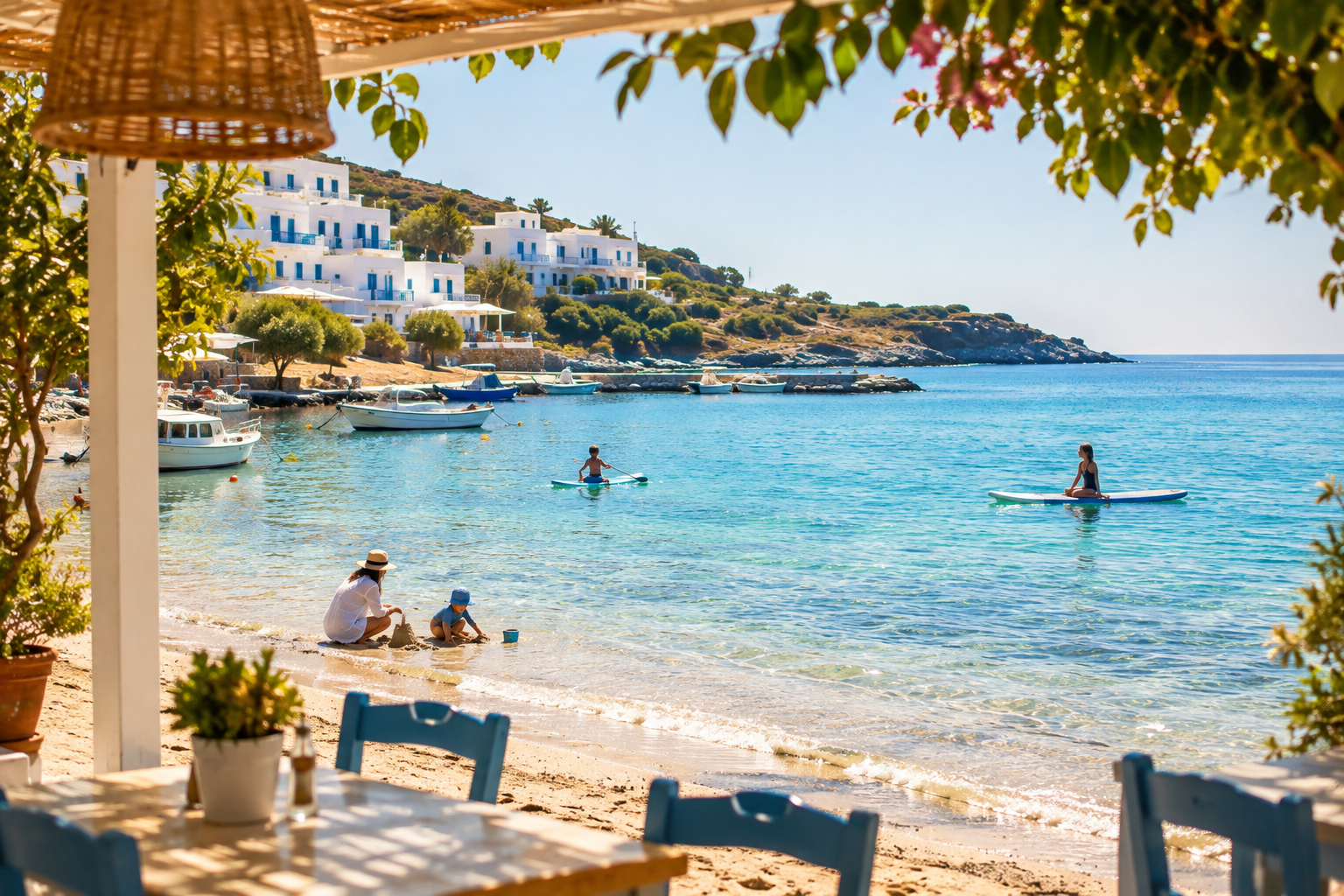
Cost tiers across Greek islands
Greek islands do not have fixed price categories. A five-star resort in a traditionally “cheaper” destination can cost considerably more than a basic apartment in a destination generally considered expensive.
As a broad shortlisting guide, you may encounter this pattern:
Often more affordable
- Corfu and other Ionian options
- Kos
- Some areas of Zakynthos and Kefalonia
Broad mid-range
- Crete
- Rhodes
- Some established Corfu resort areas
Often mid-to-upper range
- Naxos
- Paros
Frequently among the pricier choices
- Santorini
- Mykonos
Treat these as planning tendencies, not a price ranking.
The same island can have a huge spread in accommodation prices depending on:
- school-holiday dates
- number of nights
- room type
- board basis
- distance from the beach
- resort facilities
- flight availability
- family size
- transfer requirements
The best way to compare is to price the whole holiday, not just the hotel.
A £1,000 hotel that requires expensive flights, transfers and meals may cost more overall than a £1,300 all-inclusive package.
Accommodation types explained
All-inclusive resort
An all-inclusive resort can be useful when you want predictable daily spending.
Depending on the property, the rate may include meals, selected drinks, entertainment and some activities. Some resorts also have kids’ clubs.
However, never assume that “all-inclusive” means everything is included.
Check:
- drinks brands and tiers
- restaurant restrictions
- kids’ club age range
- kids’ club hours
- premium activities
- watersports
- excursions
- airport transfers
A kids’ club is also not automatically equivalent to full-day childcare.
Family villa or apartment
A villa or apartment gives you more space and flexibility.
It can work particularly well for:
- families with different bedtimes
- longer stays
- self-catering
- island-hopping
- families who want to eat some meals at home
The trade-off is that you have to manage more of the holiday yourself.
Food, cleaning, transport, transfers and activities all need to be budgeted separately.
A hire car may be useful, but it depends heavily on the property’s location.
Half-board hotel
Half-board can be a useful middle ground.
Breakfast and dinner may be included, while lunch can be taken at a beach café, taverna or during a day trip.
This works particularly well if you do not want to spend every day at the hotel.
5. When to go: June and September vs July and August
For families, the cheapest month is not always the best-value month.
You need to consider heat, crowds, opening hours and your children’s routine alongside the headline accommodation price.
|
Period |
Potential advantages |
Potential drawbacks |
|
June |
Warm weather, long days, often less intense than peak summer |
Sea temperatures can vary; some seasonal businesses may have shorter schedules |
|
September |
Warm conditions and often fewer crowds than peak summer |
Later September can bring changing weather and reduced hours in some seasonal businesses |
|
July |
Peak summer facilities, long daylight, lots of activities open |
Higher prices, crowds and strong midday heat |
|
August |
Full summer atmosphere and maximum seasonal availability |
Often the busiest and hottest period; peak pricing is common |
Why this matters with toddlers
Young children can struggle with long periods of midday heat.
That affects the practical shape of your day:
Morning: beach or pool Midday: lunch, shade and rest Afternoon: quieter activity or pool Evening: dinner and walk
Siesta-hour closures can also affect families who expect to eat lunch or shop at a particular time.
Rather than planning around a rigid timetable, check the opening hours of your actual resort area.
Getting around with kids
Ferries
Ferries can be the natural choice between islands in the same group.
But “ferry from one island to another” is not one standard journey. A short crossing between neighbouring islands can be very different from a longer route from mainland Greece.
High-speed services can reduce journey times on some routes, but schedules, operators and sea conditions vary.
For families, consider:
- departure time
- check-in requirements
- luggage
- buggy storage
- children’s tolerance for waiting
- transfer time to the port
- arrival transfer to your accommodation
Domestic flights
Flying can make sense when the islands are far apart.
The actual journey is not just flight time. You also need to account for:
- airport transfer
- check-in
- security
- boarding
- baggage
- waiting after landing
- transfer to the hotel
With a toddler, a 45-minute flight can still become a half-day travel experience.
Car hire
A car can be useful on larger islands such as Crete, Corfu and Rhodes, particularly when beaches and attractions are spread out.
On smaller or flatter islands, local buses, taxis, walking or cycling may cover much of what your family needs.
Do not hire a car automatically. First check:
- Where your accommodation is.
- How far the beach is.
- Whether restaurants are walkable.
- Whether buses serve the area.
- Which day trips you actually want.
How many islands is realistic?
For young children, one island is the simplest option.
Two islands can work well if you have enough nights to make the change worthwhile.
Three islands can work for older children and teenagers, but with toddlers it can easily turn a beach holiday into a transport itinerary.
A useful rule is to think in terms of nights rather than island count. Give each stop enough time that the family gets several genuine holiday days rather than spending a significant proportion of the trip moving between accommodation.
Cost-planning worksheet: package vs DIY
The biggest mistake when comparing a package with a villa is comparing the hotel price against the package price.
You need to compare the whole trip.
|
Cost item |
Resort/package |
Villa + flights + ferries |
|
Flights |
Often included |
Separate |
|
Accommodation |
Included in package rate |
Separate |
|
Meals |
Included or partly included |
Separate food budget |
|
Inter-island transport |
Usually not applicable |
Ferry or domestic flight |
|
Airport transfers |
May be included |
Separate |
|
Car hire |
Optional |
Potentially useful |
|
Kids’ club |
May be included |
Usually self-managed |
|
Travel insurance |
Separate |
Separate |
|
Medical contingency |
Separate |
Separate |
|
Excursions |
Usually extra |
Usually extra |
|
Spending money |
Potentially lower |
Potentially higher |
Example
Imagine a family of four comparing:
Option A: 10 nights all-inclusive in Corfu
against
Option B: 10 nights split between Naxos and Paros in a self-catering villa.
For Option B, the family needs to add:
- flights
- accommodation
- ferry tickets
- airport transfers
- car hire if needed
- groceries
- restaurant meals
- drinks
- excursions
- insurance
The villa may look cheaper at first glance, but the complete trip may not be.
Equally, an all-inclusive package is not automatically the cheaper option.
The correct comparison is:
Total package cost ÷ total DIY cost for the same family, dates, nights and broadly comparable accommodation standard.
That gives you a meaningful comparison.
Post-Brexit practicalities for UK families
If you are travelling on a British passport, check the rules before booking and again before departure because entry requirements can change.
Passport validity
For Greece, your passport needs:
- an issue date less than 10 years before the date you arrive
- an expiry date at least three months after the day you plan to leave the Schengen area
This means checking the issue date as well as the expiry date.
Older passports issued before October 2018 can be particularly important to check because some may have extended validity beyond the standard 10-year period.
Schengen 90/180 rule
British visitors can normally travel visa-free to Greece and other Schengen countries for up to 90 days in any rolling 180-day period for tourism.
The important point for families combining destinations is that the 90 days applies to the Schengen area as a whole, not separately to Greece.
Previous Schengen travel within the relevant 180-day period counts towards the limit.
EES
The EU Entry/Exit System is being implemented for short stays in the Schengen area.
UK travellers may need biometric registration, and border procedures can take additional time.
For Greece specifically, current GOV.UK guidance says Greek authorities have indicated that they will not collect fingerprints and photos from UK travellers as part of EES. Because implementation can change, check the latest official guidance before travelling.
GHIC vs EHIC
A UK GHIC can provide access to necessary state healthcare in eligible European countries on the same basis as a local resident, although some treatment may involve charges.
An existing EHIC can generally continue to be used until its printed expiry date.
The important point is that GHIC or EHIC is not a replacement for travel insurance.
It does not provide the same protection as private travel insurance for things such as medical repatriation or treatment in private facilities.
Every family member should have the appropriate card or eligibility checked before travel.

Beach and water safety checklist
Beach safety should be assessed at the specific beach and accommodation, not simply at island level.
Before choosing a family resort, check:
1. Beach access
Is the route from the accommodation genuinely easy with a buggy?
A hotel advertised as “near the beach” can still involve steep roads, stairs or a lengthy walk.
2. Sea entry
Look at how quickly the seabed becomes deeper.
A beach that looks calm from photographs can still have a rapid drop-off.
3. Lifeguard cover
Check whether there is a lifeguard and whether coverage applies during your travel dates.
Do not assume that a popular beach is continuously supervised.
4. Shade
Check whether the beach or hotel has usable shade.
With young children, shade can be just as important as the distance from the hotel.
5. Pool arrangements
If your accommodation has a pool, check:
- children’s pool
- depth
- barriers
- supervision
- opening hours
- pool rules
6. Sun protection
Use appropriate sunscreen, hats and shade, and plan breaks from direct midday sun.
A live UV forecast is more useful than assuming conditions will be identical every day.
7. Boat trips
If you book a boat excursion, confirm that appropriate child-sized life jackets are available.
8. Kids’ clubs
A kids’ club should never be treated as a replacement for direct supervision around water.
What’s usually NOT included?
Some of the biggest holiday surprises come from costs that were assumed to be included.
Airport transfers
Self-booked accommodation may not include transfers.
Check the distance from the airport and the realistic taxi or transfer cost.
Kids’ club time
A hotel may advertise a kids’ club but have:
- specific age limits
- fixed opening hours
- registration requirements
- limited sessions
- additional charges for some activities
Read the actual hotel conditions rather than relying on the phrase “kids’ club”.
Baby essentials
Families travelling with babies may need to budget separately for nappies, formula, baby food and other essentials.
Availability and prices can vary by location, particularly away from larger supermarkets.
Excursion transport
Even an all-inclusive resort does not automatically mean excursions are included.
Boat trips, transfers, entry fees and equipment can all be separate costs.
Common practicalities and overspending traps
Siesta-hour closures
Some shops and businesses may close during part of the afternoon and reopen later.
This can matter if your children normally eat early or you are travelling with a baby.
Check the local opening pattern rather than assuming every business operates continuously.
Tipping
Tipping is not a simple fixed percentage that applies everywhere.
A discretionary amount for good service may be appropriate, but do not build an inflexible percentage into your holiday budget.
Resort excursion pricing
Hotel or resort excursion desks are convenient, but convenience can come at a higher price.
Compare the resort option with reputable independent operators where appropriate, checking exactly what is included before comparing prices.
Car-hire excess
A low headline car-hire price does not necessarily represent your final cost.
Check:
- insurance
- excess
- fuel policy
- additional driver fees
- child seats
- collection charges
- deposit
Watersports
Beach-based watersports and equipment hire can add up quickly.
If your family expects to use equipment repeatedly, compare the total cost rather than treating each small charge separately.
Step-by-step: how to book a family beach holiday in Greece
Step 1: Decide your holiday style
Choose between:
- single resort base
- villa/apartment
- half-board hotel
- two-island trip
Do this before choosing an island.
Step 2: Identify your children’s priorities
Ask:
- Do they need a kids’ club?
- Is a pool essential?
- Do they need shallow beach access?
- Will they enjoy watersports?
- How much travel can they tolerate?
Step 3: Shortlist two or three islands
Use the age-band guide as a starting point.
Do not shortlist eight islands and then try to compare every hotel on each one.
Step 4: Choose the resort area
This is one of the most important steps.
A family-friendly island does not mean every resort area on that island will suit your family.
Step 5: Compare accommodation types
Price an all-inclusive resort against a villa or half-board hotel.
Check what is actually included.
Step 6: Compare dates
Try several possible weeks around June, July, August and September.
Look at the total holiday price rather than assuming one month is always cheapest.
Step 7: Fill in the cost worksheet
Add every major expense before deciding.
Step 8: Check your travel documents
Check passport validity, Schengen requirements and healthcare arrangements well before departure.
Step 9: Arrange insurance
Make sure the policy covers the whole family and any activities you expect to do.
Step 10: Confirm the details that matter to children
Before final payment, check:
- kids’ club age range
- kids’ club hours
- transfer time
- beach access
- pool depth
- shade
- room configuration
- cot availability
- meal arrangements
That final check can prevent many of the disappointments that do not show up in a headline hotel description.
Pros and cons: resort base vs island-hopping
|
Approach |
Pros |
Cons |
|
Resort base |
Easier routine, fewer transfers, predictable spending, less packing |
Less variety |
|
Island-hopping |
More beaches, scenery and experiences; can suit older children |
More logistics, transfers and separate costs |
Resort base makes more sense if:
- you have toddlers
- you want an easy first Greece trip
- your children enjoy pools and organised activities
- you dislike frequent packing
- predictable spending matters
Island-hopping makes more sense if:
- your children are older
- everyone enjoys exploring
- you want several different island experiences
- you are comfortable managing ferry or flight schedules
- you are willing to trade simplicity for variety
FAQ
What is the best Greek island for toddlers?
There is no single best island for every toddler. Start with the resort area rather than the island name and prioritise short transfers, easy beach access, shade, suitable pool facilities and accommodation that fits your child’s routine.
Crete, Corfu, Rhodes, Kos and parts of Naxos can all be useful starting points, but the specific beach and resort matter more than a general island reputation.
Do I need a car in Greece with kids?
Not necessarily.
A car can be useful on larger islands such as Crete, Corfu and Rhodes, particularly if you want to explore beaches outside the main resort areas.
On smaller or flatter islands, local buses, taxis, walking or cycling may be enough.
Check your exact accommodation location before paying for car hire.
Is Greece expensive for a family holiday?
It depends heavily on the island, dates, accommodation and board basis.
Santorini and Mykonos can be expensive, while some areas of Corfu, Kos and other Ionian islands can offer lower-cost options.
But island reputation is only a starting point. Compare actual prices for your dates and family size.
Which Greek island has the calmest sea for children?
There is no reliable island-wide answer.
Sheltered bays can provide calmer conditions, but wind, waves and sea-floor conditions can vary between beaches on the same island.
Check the specific beach near your accommodation rather than assuming an entire island has calm water.
Is a villa cheaper than an all-inclusive resort?
Not automatically.
A villa may have a lower accommodation price but requires you to add food, transfers, car hire, ferries and other costs separately.
An all-inclusive package may have a higher headline price but include more of the holiday.
Use the complete cost worksheet for a like-for-like comparison.
Is all-inclusive good for families?
It can be particularly useful for families who value predictable spending and on-site facilities.
But check exactly what the resort includes, especially kids’ club hours, drinks, activities and room arrangements.
How many Greek islands should we visit with young children?
One island is the simplest option.
Two islands can work well with enough time at each stop. Three or more usually makes more sense for families who are comfortable with frequent changeovers and more complex transport.
Conclusion
There is no single formula for family beach holidays in Greece.
For families with young children, the simplest starting point is usually one well-chosen resort base rather than trying to see several islands in one trip. Crete, Corfu, Rhodes and Kos offer plenty of family-oriented options, but the specific resort area, beach access and accommodation facilities matter more than the island name alone.
For families with older children and teenagers, two-island trips can add useful variety without requiring the constant movement of a more ambitious island-hopping itinerary.
June and September are worth comparing with July and August if you want to balance warmth, crowds and pricing, but no month is automatically cheapest for every family. The best-value week is the one where the complete combination of flights, accommodation, transfers, meals and activities works for your budget.
Most importantly, compare the whole trip rather than one headline price. A package is not automatically cheaper than a villa, and a villa is not automatically cheaper than an all-inclusive resort.
If you shortlist a few islands, compare the actual resort areas and then fill in the cost worksheet using your real dates and family size, you will have a much more useful basis for choosing your Greek beach holiday than a generic “best island” ranking.
Sources
For current UK travel requirements, check the official GOV.UK Greece entry requirements page before travelling.
For GHIC and EHIC information, check the NHS guidance on healthcare cover abroad.
Travel rules, border procedures and healthcare arrangements can change, so official government and NHS guidance should take priority over older travel information.