

Cheap holidays in Tunisia
Tunisia is one of the shortest, cheapest routes to reliable winter and shoulder-season sun from the UK — a roughly three-hour flight to a Mediterranean coastline where a week’s half-board or all-inclusive package can undercut equivalent trips to Spain or Turkey by a wide margin. But “cheap” here covers two genuinely different kinds of trip: a package to a beach resort in Hammamet or Sousse, and independent, multi-stop travel taking in the Sahara and Roman ruins further south. This guide treats both fairly, works through what a Tunisia holiday actually costs once every extra is counted, and covers the practical detail — visa-free entry rules, current regional safety guidance, and the Tunisian dinar’s quirks — that most single-trip blog reviews don’t have room for.
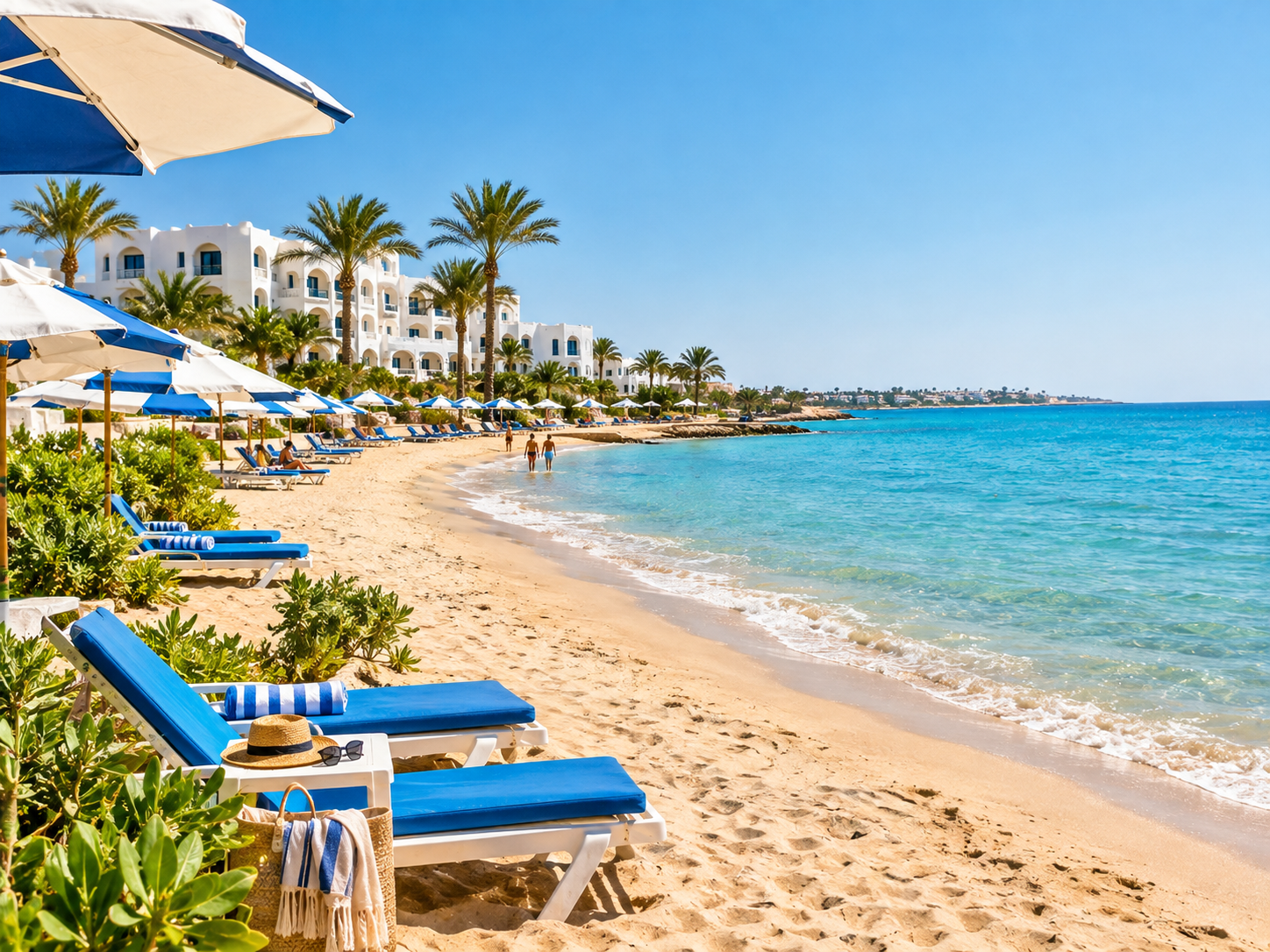
Quick answer: Tunisia’s main package-holiday coast runs from Hammamet in the north down through Sousse, Port El Kantaoui and Monastir to Mahdia, with Djerba as a separate island option further south. Most of this coastline is cheap by Mediterranean standards — a week’s half-board or all-inclusive package is commonly available from under £300–£400 per person outside peak summer.
British passport holders don’t need a visa for stays up to 90 days, but the Tunisian dinar can’t be bought in the UK in advance or converted back afterwards, and current UK government advice does mark out specific inland and border areas to avoid. None of this is difficult to plan around — the sections below walk through exactly what to check before you book.
Comparing Tunisia’s main resort regions
|
Region |
Typical trip style |
Roughly how it compares on cost |
Good to know |
|
Hammamet / Yasmine Hammamet |
Family and couples package resorts, medina, modern marina strip |
Among the most competitively priced of the main resort towns |
The most-reviewed resort area in this guide’s research — a large concentration of package hotels and holiday villages |
|
Sousse / Port El Kantaoui |
Family resorts, marina, UNESCO-listed medina |
Similar cost band to Hammamet |
Closer to day-excursion sites (El Jem, Kairouan) than Hammamet |
|
Monastir |
Quieter resort town, smaller-scale hotels |
Comparable to or slightly cheaper than Sousse |
Has its own international airport, cutting transfer time |
|
Mahdia |
Lower-key, less built-up beach town |
Positioned by several sources as one of the more laid-back, lower-cost options |
Fewer large package hotels — worth checking availability before assuming it’s covered by every operator |
|
Djerba |
Island resort, separate from the mainland coast |
Broadly similar cost band to the mainland coast, sometimes with a longer or connecting flight |
A ferry/causeway link to the mainland; culturally and historically distinct (its old synagogue is a noted heritage site) |
Costs here are relative rankings drawn from this guide’s research, not fixed prices — compare live quotes for your own dates before deciding between regions, since pricing shifts with the season and specific hotel.
Package holiday or independent travel?
Both routes into Tunisia are genuinely cheap, but they suit different trips:
- A package holiday (flight, transfer and hotel bundled together, usually with an ATOL-protected UK travel company) suits a single-base beach trip — spend your week at a resort in Hammamet or Sousse, with the option of a day excursion inland. This is the simpler option for families and for anyone who wants a fixed, upfront total price.
- Independent travel (booking flights and accommodation separately) suits a multi-stop trip taking in Tunis, the Sahara around Douz and Tozeur, and Roman sites like El Jem and Dougga. It’s often cheaper per day once you’re there, but it takes more planning, involves more infrastructure that isn’t geared to package tourists (louages, inter-city trains, guesthouses), and gives up the fixed-price certainty and ATOL protection of a package.
If you’re not sure which fits, a useful middle ground is a package stay at a coastal resort with one or two organised day excursions booked separately, rather than trying to fully self-plan a multi-region trip on a first visit.
Board basis explained
|
Board basis |
What’s typically included |
What to check |
|
Self-catering |
Accommodation only, sometimes with a basic kitchenette |
Nearest supermarket/market for food shopping |
|
Half-board |
Breakfast and dinner |
Whether drinks are included with dinner, and what lunch options exist nearby |
|
Full-board |
Breakfast, lunch and dinner |
Whether snacks and drinks between meals are extra |
|
All-inclusive |
Meals plus a stated range of drinks, and often some activities/kids’ club access |
Which drinks brands are included vs. charged as “premium,” and whether it’s a 24-hour or restricted-hours all-inclusive |
Board-basis inclusions vary by hotel even within the same tier — check the specific property’s written inclusions rather than assuming from the “all-inclusive” label alone, the same caution that applies everywhere else in the Mediterranean.
Booking timeline: when to go for the best value
- Shoulder season (April–May, September–October) is consistently flagged across independent travel guides as the best balance of price and weather — warm without the intensity of high summer, and typically cheaper than the July–August peak.
- Peak summer (July–August) brings the hottest weather and the highest package prices; if you’re set on summer travel, our cheap holidays in April and July all-inclusive holidays guides cover how to manage cost at both ends of that trade-off elsewhere in the Mediterranean.
- Winter and early spring (November–March) can bring some of the lowest package prices of the year, but expect cooler, more variable weather, including the occasional rainy spell reported by UK visitors travelling in this window — pack accordingly rather than assuming guaranteed beach weather. Our winter package holidays and November holiday deals guides cover the same low-season trade-off for other destinations.
- Ramadan shifts each year on the Islamic calendar and affects restaurant and shop opening hours outside tourist hotels — check the current dates against your travel window if this matters to your plans.
Cost-planning worksheet: package vs. booking separately
Use this to compare a like-for-like trip — same dates, same length of stay, same number of travellers — rather than comparing a headline package price against a rough guess at DIY costs.
|
Cost item |
Package holiday |
Booking separately |
|
Flights |
Included in package price |
Price per person, return |
|
Transfers |
Usually included |
Cost of taxi/shuttle each way |
|
Accommodation (per night × nights) |
Included in package price |
Hotel/guesthouse rate × nights |
|
Board basis (meals) |
Included per package tier |
Estimated daily food spend if self-catering or independent |
|
Local transport for excursions |
Often extra even on all-inclusive |
Louage/train/taxi fares |
|
Hotel tax (8–12 TND per night, paid locally) |
Usually payable on top, locally |
Same — payable at check-in regardless of booking route |
|
Spending money (drinks not included, souvenirs, tips) |
Add on top of package price |
Add on top of independent total |
|
Travel insurance |
Add if not already included |
Add |
|
Total for these dates |
£ |
£ |
A note on the hotel tax: GOV.UK’s entry-requirements guidance confirms a local hotel tax of 8–12 Tunisian dinars per night depending on hotel classification, payable in Tunisia rather than at UK booking — budget for it separately from your package or room price.
Currency and cash: the Tunisian dinar
The Tunisian dinar (TND) is a closed currency, which changes how you should plan spending money:
- You can’t buy TND in the UK before you travel. Bring sterling or euros in cash, and exchange on arrival — at the airport, a bank, or your hotel.
- Bringing foreign currency in: amounts up to roughly 20,000 TND (around £5,100) don’t need to be declared on arrival; larger amounts should be declared to customs. [VERIFY — confirm this threshold on the official Tunisian customs site or with your airline before travelling, since it’s sourced from a money-transfer company’s guide rather than a Tunisian government page.]
- Taking dinar out of Tunisia: exporting more than roughly 3,000 TND (around £770) needs to be declared. [VERIFY — same caveat as above.]
- You can’t convert leftover dinar back to sterling once you’re home. The Tunisian dinar isn’t a freely convertible currency outside Tunisia, so plan to spend down your cash before you leave rather than relying on being able to change it back in the UK.
- Reconverting a small amount back at the airport before departure is something some travellers report being able to do if they’ve kept their original exchange receipts, but the rules and limits are inconsistently described across sources — don’t count on this, and treat “spend it before you fly home” as the safer assumption.
- Exchange at banks, hotels or airport bureaux rather than informal street exchange, which carries a real fraud risk.
What’s usually not included, even in a cheap package
- Checked baggage, seat selection and priority boarding on the flight, unless specifically stated
- Airport transfers, if booked as a flight-and-hotel-only deal
- Excursions inland (Sahara day trips, El Jem, Dougga, Tunis city tours)
- Premium/imported drinks brands even on all-inclusive boards
- The local hotel tax, payable in Tunisia regardless of what your package price covers
- Travel insurance

Food, water and health safety checklist
- Stick to sealed bottled water for drinking; check with your hotel about ice and tap-water treatment standards
- Confirm whether resort restaurants serve tap water mixed into juices or other drinks if you want to avoid it entirely — this has been flagged as inconsistent hotel-to-hotel in independent trip reports
- Pack basic travel sickness remedies (rehydration sachets, an anti-diarrhoeal) as a sensible precaution, as several independent travellers recommend for Tunisia specifically
- Check routine vaccination status is up to date before any trip, and consult a travel health service or GP for personalised advice
- Use sun protection seriously, particularly for children, given the strength of the Mediterranean/North African sun even outside peak summer
Common scams and tourist traps
- “I’m your hotel’s chef/waiter”-style approaches from people outside the resort claiming a staff connection to build trust before selling something — politely decline and verify with actual hotel staff if unsure
- Medina pressure-selling: self-appointed “guides” who follow you into the souks and then demand payment for an unsolicited tour — be clear early that you don’t want a paid guide
- Marked-up taxi fares arranged through hotels — ask locals or check a ride app’s estimated fare where available, and agree taxi prices (or insist on the meter) before setting off
- Overpriced or poor-quality souvenir shops steered to by unofficial “guides” who receive a commission — a habit reported across several independent Tunisia trip accounts
Practical planning: entry rules, safety and best time to visit
Visa and passport rules
British passport holders can visit Tunisia without a visa for stays of up to 90 days for tourism, according to current GOV.UK guidance. Your passport should be valid for the full duration of your stay, and a damaged or badly worn passport can cause problems when leaving the country — check its condition well before you travel.
Overstaying the 90-day limit without a valid reason results in a fine payable locally. Border officials may ask for your onward or return travel ticket and proof of accommodation, so keep these accessible. Crown Dependency (Guernsey, Jersey, Isle of Man) passport holders may need to buy a visa on arrival — check current requirements for your specific passport before travelling. [Source: GOV.UK Tunisia entry requirements — confirm current terms before booking, since visa rules can change.]
Safety and regional risk
Current FCDO travel advice advises against all travel to specific areas of Tunisia, and against all but essential travel to further areas — almost all concentrated in the west, near the Algerian border, and the south, near the Libyan border, rather than along the main package-holiday coast:
Advises against all travel to:
- The Chaambi Mountains National Park and the designated military operations zones of Mount Salloum, Mount Sammamma and Mount Mghila (western Tunisia)
- The militarised zone south of the towns of El Borma and Dhehiba, and within 20km of the rest of the Tunisia–Libya border area north of Dhehiba (southern Tunisia)
- The town of Ben Guerdane and its immediate surrounding area
Advises against all but essential travel to:
- Areas north and west of the town of Ghardimaou in Jendouba Governorate, including El Feidja National Park
- Within 20km of the Tunisia–Algeria border in El Kef and Jendouba governorates, south of the town of Jendouba
- Kasserine Governorate, including the town of Sbeitla
- Within 10km of the rest of the Tunisia–Algeria border south of Kasserine Governorate, and within 10km of Mount Mghila
- Mount Orbata
- Within 75km of the Tunisia–Libya border, including Remada and El Borma — but excluding Zarzis, the C118 road, and all areas in Medenine Governorate north of that road
None of these areas sit on the standard Hammamet–Sousse–Monastir–Mahdia package coast or Djerba, but they matter directly if you’re planning independent travel further inland or south, including any Sahara excursion that ventures close to the Algerian border. The FCDO also assesses that terrorists are likely to try to carry out attacks in Tunisia, with tourist venues, religious sites, government buildings and public transport among the higher-risk locations, and a state of emergency has been in place since 2015.
Political demonstrations can start with little warning and occasionally disrupt transport. Check the current GOV.UK Tunisia travel advice in full — including its regional-risks map — for your specific resort, any excursion, and your travel dates before booking, rather than relying on a general “is Tunisia safe” impression from any single source, including this one.
Financial protection
If your trip includes a flight and is booked through a UK travel company, check whether it’s ATOL-protected — this matters if the company were to collapse before or during your trip. Financial protection terms differ between a flight-inclusive package and separately booked flights and accommodation, so it’s worth checking what protection (if any) applies to each part of your booking.
Combining the coast with the Sahara and Roman sites
Tunisia’s inland and southern attractions are a genuinely different kind of trip from a beach resort stay, and worth planning as a distinct add-on rather than assuming they’re a short hop from your hotel:
- Day excursions from the coast: El Jem’s Roman amphitheatre and Kairouan’s Great Mosque are commonly reachable as day trips from Sousse or Monastir; Carthage, Sidi Bou Said and Tunis’s medina are a similar day-trip distance from Hammamet.
- A dedicated Sahara add-on: desert towns like Douz, Tozeur and Matmata (the troglodyte cave-dwelling villages, also known for Star Wars filming locations) sit much further south and inland, and are usually visited as a separate multi-day extension rather than a single day trip from the coast.
- Check any excursion’s route against the regional-risk areas listed above before booking, particularly for trips heading toward the Algerian border region.
Step-by-step: how to book a cheap Tunisia holiday
- Decide between a single-base coastal package and a multi-stop independent trip, using the framework above.
- Compare live package prices across Hammamet, Sousse, Monastir, Mahdia and Djerba for your exact dates.
- Check the specific hotel’s board-basis inclusions in writing, not just the tier name.
- Confirm ATOL protection if your package includes flights.
- Check your passport’s validity and condition against the 90-day visa-free entry rule.
- Read the current FCDO regional-risk guidance in full, especially if you’re planning any inland excursion.
- Budget separately for the local hotel tax, excursions, and spending money beyond your package price.
- Bring sterling or euro cash to exchange on arrival, since TND can’t be bought in the UK in advance.
- Book excursions either through your resort or a reputable operator, rather than an unsolicited medina “guide.”
- Plan to spend down your remaining dinar before departure, rather than counting on converting it back.
Pros and cons of a cheap Tunisia holiday
|
Pros |
Cons |
|
Among the cheapest short-haul (roughly 3-hour) winter and shoulder-season sun options from the UK |
Tunisian dinar can’t be bought before travel or converted back afterwards |
|
Visa-free entry for British passport holders for stays up to 90 days |
Specific inland/border regions carry current official travel-advice warnings |
|
Genuine cultural and historical depth (Carthage, El Jem, Sahara) alongside standard beach resorts |
Independent multi-stop travel takes more planning than a single-resort package |
|
Wide range of board-basis options, including all-inclusive family resorts |
Board-basis inclusions and safety standards (food/water) vary noticeably by hotel |
Frequently asked questions
Is Tunisia safe for a holiday?
Current UK government advice advises against all travel to specific western and southern border areas, and against all but essential travel to further areas nearby — none of which sit on the main Hammamet–Sousse–Monastir–Mahdia coast or Djerba. Check the full, current FCDO regional-risk guidance for your resort and any planned excursion rather than relying on a general impression either way.
Do UK citizens need a visa for Tunisia?
No, British passport holders can visit for tourism without a visa for stays of up to 90 days, though your passport must be valid for the whole stay and in good condition. Check current GOV.UK guidance before travelling, since entry rules can change.
How much does a cheap Tunisia holiday cost?
It varies by resort, season and board basis, but Tunisia is consistently positioned as one of the more affordable short-haul Mediterranean options — package deals outside peak summer are commonly available well under what similar trips to Spain or Turkey cost. Compare live quotes for your specific dates using the cost-planning worksheet above rather than relying on a single headline figure.
Can I use my leftover Tunisian dinar after I get home?
No — the dinar isn’t a freely convertible currency outside Tunisia, so you can’t exchange it back to sterling once you’re back in the UK. Spend down your cash before departure rather than planning to convert it afterwards.
Is Hammamet or Sousse better for a family holiday?
Both are well-established, heavily reviewed package resort areas with a strong choice of family and all-inclusive hotels; Sousse sits somewhat closer to day-excursion sites like El Jem and Kairouan, while Hammamet has a larger concentration of resort hotels in this guide’s research. Compare specific hotels and live prices for your dates rather than assuming one town is universally cheaper or better.
What’s the best time of year to visit Tunisia?
Shoulder season (April–May and September–October) is widely recommended for a balance of warm weather and lower prices. Summer (July–August) is hottest and most expensive; winter (November–March) can be cheapest but brings cooler, more variable weather.
Do I need any vaccinations for Tunisia?
There’s no blanket answer here — check with a GP or travel health service for advice based on your own health history and itinerary, particularly if you’re planning to travel beyond the main resort coast.
Final verdict
Tunisia earns its reputation as one of the cheapest short-haul Mediterranean options from the UK, with a well-established, affordable package-resort coast from Hammamet down to Mahdia, plus a genuinely distinct independent-travel option further inland and south. The trip that goes wrong is usually the one where nobody checked the Tunisian dinar’s quirks, the current regional-risk guidance for an inland excursion, or what a specific hotel’s board basis actually includes. Work through the cost-planning worksheet and the checklists above for your own dates and hotel, and you’ll have a clear, current picture of what your trip actually costs and covers before you book.
Sources
- GOV.UK: Tunisia travel advice — entry requirements
- GOV.UK: Tunisia travel advice — safety and security
- GOV.UK: Tunisia travel advice — regional risks
- Western Union: Guide to Tunisian currency
Never Ending Footsteps, The Broke Backpacker, Against the Compass, We Will Nomad, Travel Mad Mum, Temple Seeker, From Blue to Green, MadeForMums and Globetotting (see this guide’s companion competitor-analysis document for full citations) — used for cross-checking board-basis, cost-range and practical-tip claims that aren’t official-source-specific