
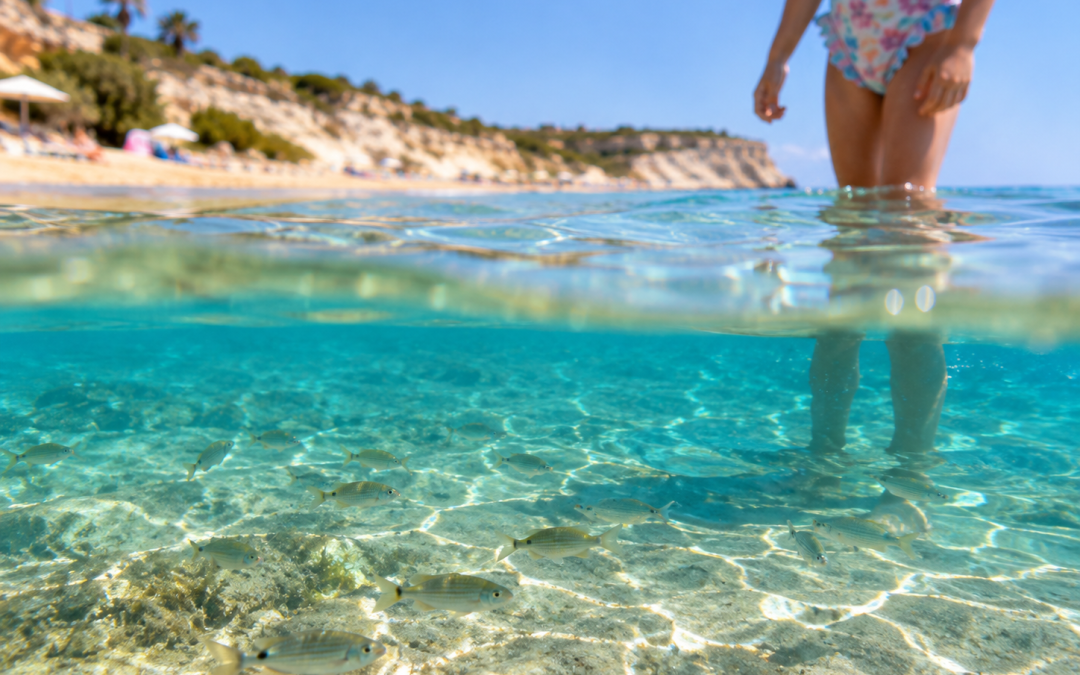
Beach Holidays in Cyprus
Cyprus doesn’t get talked about in quite the same breath as Spain or Greece for a UK family beach holiday, but it should: a roughly 4.5-hour flight, some of the most consistently warm, calm water in the Mediterranean, and a spread of resort towns that range from big and lively to small and quiet. It also comes with a couple of genuinely important quirks most single-hotel blog guides skip past entirely — Cyprus is EU territory but sits outside the Schengen area, and the island is politically divided in a way that carries real, current entry-rule consequences if you’re not aware of it before you book.
This guide compares Cyprus’s family resort towns fairly, works through what a package actually costs once everything is counted, and covers the practical detail — entry rules, a specific current UK government warning about flying into the island’s north, and beach and road safety — that gets a family holiday off to the right start.
Quick answer: Protaras, Paphos (including Coral Bay) and the quieter parts of Limassol are the resort areas most consistently recommended for families, thanks to calm, shallow beaches and organised family infrastructure; Ayia Napa’s centre is built around nightlife rather than young children. A week’s all-inclusive package for a family of four commonly runs from roughly €1,600 at three-star level to over €3,000 at five-star, before extras.
British passport holders don’t need a visa for a standard holiday, but — unlike Spain, Greece or Majorca — Cyprus is not in the Schengen area, and flying directly into the island’s north carries a specific legal risk covered in full below. The sections that follow cover exactly what to check before you book.
Comparing Cyprus’s family resort towns
|
Resort area |
Typical trip style |
Roughly how it compares on cost |
Good to know |
|
Protaras |
Calm, family-oriented resort built around Fig Tree Bay |
Mid-range |
Especially shallow, sheltered water — one of the most recommended areas for young children |
|
Paphos (town) |
Culture-plus-beach base with UNESCO sites nearby |
Mid-range to upper-mid-range |
Broader mix of things to do beyond the beach; a calmer feel than the nightlife resorts |
|
Coral Bay (near Paphos) |
Purpose-built family beach resort |
Mid-range |
Shallow, sandy, well-organised with amenities close to the beach |
|
Limassol |
Cyprus’s second city, mixing beach with urban dining and nightlife |
Mid-range to upper-mid-range |
Family-friendly in its quieter resort stretches, livelier and less child-focused nearer the centre |
|
Larnaca |
Airport-adjacent gateway city |
Budget to mid-range |
A practical short-stay base without needing a hire car, though beaches are more functional than scenic |
|
Polis/Latchi |
Small, quiet, undeveloped resort in the west |
Mid-range to upper-mid-range |
Suits families wanting a quieter, less built-up trip over big-resort infrastructure |
|
Ayia Napa |
Cyprus’s main nightlife resort |
Can appear cheap on headline price |
The centre is not recommended as a family base — see the dedicated section below |
Costs here are relative rankings drawn from this guide’s research, not fixed prices — compare live quotes for your own dates before deciding between resort areas, since pricing shifts with the season and specific hotel.
Where not to stay with young children
Ayia Napa’s central strip is built around nightlife rather than family tourism, in much the same way Magaluf functions on Majorca — busy late-night bars, clubs and a dedicated party-focused stretch of accommodation. This doesn’t mean the wider Ayia Napa area is off-limits: some of its beaches (Nissi Beach, Konnos Bay) are genuinely well-suited to families, and Protaras — effectively an extension of the same coastline — is consistently described as the calmer, more family-oriented alternative right next door. The practical takeaway is the same one that applies everywhere: check exactly which part of a resort area, and which specific hotel, you’re booking into, rather than assuming a whole named resort is uniformly family-friendly or uniformly a party destination.
Board basis explained: what’s typically included
|
Board basis |
What’s typically included |
Good for |
|
Self-catering |
Accommodation only, sometimes with a basic kitchenette |
Families who want to control food costs and timing, especially with younger children who eat on their own schedule |
|
Half-board |
Breakfast and one main meal, usually dinner |
A middle-ground option that still leaves flexibility for lunch out or on the beach |
|
All-inclusive |
Meals, standard drinks (often excluding premium brands), and sometimes basic activities or kids’ club access |
Families who want to fix the holiday’s cost upfront and avoid constant on-the-day spending decisions |
Board-basis inclusions vary meaningfully between hotels even at the same star rating and the same resort — check exactly what “all-inclusive” covers (drink brands, hours, à la carte access, kids’ club charges) for the specific property before assuming it matches a different hotel you’ve stayed at elsewhere.

Which resort suits which age group
- Babies and toddlers: Protaras’ Fig Tree Bay and Coral Bay near Paphos are both frequently recommended for their especially shallow, calm water and gently sloping sand.
- Primary-school-age children: Coral Bay and the wider Protaras area combine organised beach facilities with enough nearby activity (water parks, boat trips) to fill a week.
- Teens: Limassol’s mix of beach, dining and city-adjacent activity, and Ayia Napa’s family-friendly beaches (Nissi Beach, Konnos Bay) away from the nightlife strip, tend to suit older children better than the quieter, smaller resorts.
- Mixed-age families: Paphos’ broader range of things to do — beaches, cultural sites, day trips — makes it easier to satisfy both younger and older children across a longer stay.
Specific hotel choice matters as much as the resort area — read reviews for the actual property before booking, and check which specific beach it sits on, since conditions can differ noticeably along the same stretch of coast.
Do you need to hire a car?
Larnaca, and the main hotel strips in Protaras and Ayia Napa’s family beaches, are workable without a car for a standard resort-based stay with organised excursions. Paphos, Coral Bay and Limassol benefit from a car if you want to explore beyond the immediate resort — Cyprus’s inland villages, the Troodos mountains and archaeological sites are considerably easier to reach with your own transport. Polis/Latchi, being more remote, is more car-dependent than the other resort areas listed above. If your plans include crossing into Northern Cyprus, read the car-hire and insurance section below before assuming your existing rental cover applies.
Booking timeline: when to go for the best value
- Peak season (July and August, and UK school summer holidays) is the hottest, busiest and most expensive time to visit — daytime temperatures regularly exceed 30°C and can push past 40°C inland.
- Shoulder season (May, June, September, October) is consistently recommended for a good balance of warm weather and lower prices.
- Winter (November to March) brings some of the lowest room rates of the year, though it’s a much less reliable choice for a beach-focused family trip.
- For the peak-summer end of that range specifically, our July all-inclusive holidays guide covers the same seasonal value trade-off in more depth.
Cost-planning worksheet: package total vs. flights, car hire and extras
Use this to compare a like-for-like trip — same dates, same length of stay, same number of travellers — rather than comparing a headline package price against a rough guess at DIY costs. As a reference point, independent research puts a 7-night, three-star all-inclusive package for a family of four at roughly €1,600–€2,100, rising to €2,800–€3,200 at five-star level, with hidden extras (premium drinks, à la carte dining, water sports) adding a further €180–€320 a week on average; a separate cost-tracking study put on-the-ground family spending money (food, drinks, sun kit, one water-park day) at around £395 for a week in Paphos in July 2026. Treat all of these as a starting benchmark rather than a quote, and compare live prices in your own currency for your specific dates.
|
Cost item |
Package holiday |
Booking separately |
|
Flights |
Included in package price |
Price per person, return |
|
Transfers |
Usually included |
Cost of taxi/shuttle each way |
|
Accommodation (per night × nights) |
Included in package price |
Hotel rate × nights |
|
Board basis (meals) |
Included per package tier |
Estimated daily food spend if self-catering |
|
Car hire (if your resort/plans need one) |
Rarely included |
Add separately, including excess insurance — and check north/south coverage if you plan to cross the Green Line |
|
Excursions (Troodos mountains, boat trips, water parks) |
Extra even on all-inclusive |
Extra either way |
|
Spending money (drinks not included, souvenirs, tips) |
Add on top of package price |
Add on top of independent total |
|
Travel insurance |
Add if not already included |
Add |
|
Total for these dates |
£ |
£ |
Entry requirements for UK travellers: Cyprus is EU, but not Schengen
This is the detail most competing guides miss entirely, and it’s genuinely useful for anyone who travels around Europe more than once a year:
- Passport rules: your passport needs a date of issue less than 10 years before your arrival date, an expiry date at least 3 months after your planned departure, and at least one blank page.
- Visa-free entry: British passport holders can visit Cyprus for up to 90 days for tourism, visiting family, business or short-term study, without a visa. Border control may ask for proof of onward travel and sufficient funds.
- Cyprus is not part of the Schengen area. This means your 90-day visa-free stay in Cyprus runs on its own, separate allowance — time spent in Cyprus does not count against your Schengen 90/180-day limit, and vice versa. For a family who has already used a chunk of their Schengen days elsewhere in Europe that year, this can make Cyprus a genuinely useful option.
- Because Cyprus isn’t in Schengen, the EU’s EES biometric entry system (fingerprints and photo on arrival) that now applies across most of Spain, Greece and other Schengen countries doesn’t apply here.
- Health cover: carry a valid GHIC alongside separate travel insurance, since the GHIC covers necessary state healthcare only and doesn’t substitute for full travel insurance.
[Source: GOV.UK Cyprus travel advice — entry requirements — confirm current terms before booking, since entry rules can change.]
Northern Cyprus: the entry warning most families never hear about
Cyprus has been divided since 1974 along the UN-monitored “Green Line,” with the island’s south forming the internationally recognised Republic of Cyprus and the north self-declared as the Turkish Republic of Northern Cyprus (TRNC) — a status the UK government does not recognise. This matters directly for how you book:
- Flying directly into Ercan Airport in the north is treated by Republic of Cyprus authorities as illegal entry. Current UK government advice warns this can result in fines, refusal of entry, or an exit ban — a real risk for families tempted by cheaper package deals advertised for the island’s north.
- You can legally cross between south and north at designated crossing points, and current guidance notes that some crossings (such as Ledra Palace and Ledra/Lokmaci Street) are pedestrian-only.
- Time spent in the north during a day trip or crossing still counts toward your overall 90-day limit.
- Currency differs either side of the line: the euro is used in the Republic of Cyprus (south), while the Turkish lira is used in the north — worth planning for if a day trip across the Green Line is part of your itinerary.
- Car hire insurance is a genuine practical snag: vehicles hired in the Republic of Cyprus often aren’t insured for driving in the north. Some crossing points, including Agios Dometios, offer temporary insurance for sale on the spot — but it’s far simpler to check this with your hire company before you travel if a crossing is part of your plan.
None of this affects a standard family holiday that stays within the Republic of Cyprus resort areas covered elsewhere in this guide, but it’s essential reading if a Northern Cyprus day trip — or, especially, a package holiday advertised into the north — is on your radar.
[Source: GOV.UK Cyprus travel advice — safety and security and entry requirements — confirm current terms before booking, since guidance can change.]
What’s usually not included, even on all-inclusive
- Checked baggage, seat selection and priority boarding on the flight, unless specifically stated
- Airport transfers, if booked as a flight-and-hotel-only deal
- Car hire, even where day trips inland or across the Green Line effectively need one
- Premium or imported drinks brands, and often à la carte restaurant visits beyond a set weekly allowance
- Excursions (Troodos mountains, boat trips, water parks, Northern Cyprus day trips)
- Travel insurance
Beach and water safety checklist
- Current UK government advice describes swimming in Cyprus as generally safe, but warns that some beaches see strong waves and currents — follow posted warning signs, use recognised/approved beaches, and check conditions at your specific beach rather than assuming a resort area is uniformly calm.
- A red flag confirmed in general beach-safety guidance for Cyprus means don’t enter the water; [VERIFY] the full colour-coded flag system (e.g. green/yellow) for your specific resort locally, since this wasn’t confirmed island-wide across sources for this guide.
- Protaras’ Fig Tree Bay and Coral Bay near Paphos are commonly recommended for especially shallow, calm water suited to young or weaker swimmers; smaller or more exposed beaches elsewhere on the island can have more variable conditions and less consistent lifeguard cover.
- Lifeguard cover on Cyprus’s main beaches is generally described as a peak-season (summer) provision rather than year-round — check specifically for your travel dates if you’re visiting outside the main summer months.
- Sun strength is high through the summer months, with temperatures capable of exceeding 40°C inland — use proper sun protection and check shade availability at your specific hotel and beach, particularly for young children.
Current safety notes for families
A few genuinely current points worth knowing before you travel, none of which should put you off a standard family holiday but which are worth being aware of:
- Wildfire risk is high from April to October. Current UK government advice recommends registering your mobile phone to receive local emergency alerts, since wildfire situations “can change quickly.”
- Regional tensions: current guidance notes that events elsewhere in the Middle East have led to heightened tensions and the possibility of demonstrations in Cyprus — the advice is simply to avoid all protests and political gatherings, which shouldn’t affect a standard resort-based family holiday.
- Drink safety: the same general vigilance advised across the Mediterranean applies here — buy your own drinks, keep them in sight, and be aware that drug-assisted assault (including with GHB) is flagged as a specific current risk in UK government guidance.
- Road safety: Cyprus has a higher rate of road deaths relative to population than the UK. Penalties for not wearing a seatbelt, non-compliant motorcycle helmets, mobile phone use while driving, and drink-driving are enforced and can be significant — worth factoring in if your plans include a hire car.
[Source: GOV.UK Cyprus travel advice — safety and security — confirm current terms before booking, since guidance can change.]
Cyprus vs. Greece vs. Malta for families
These three sit close together in a lot of UK families’ shortlists, and each has a different profile for a beach-focused trip:
- Cyprus: the longest flight of the three from most UK airports (around 4.5 hours), but reliably warm water and weather across a long season, EU membership without Schengen’s rules, and a genuinely distinct add-on option (Troodos mountains, Northern Cyprus day trips) beyond the beach.
- Greece: shorter flight time to many islands, in the Schengen area (so it does count against the 90/180-day Schengen limit), and an enormous range of island choices at very different price points.
- Malta: the shortest flight of the three, also Schengen, smaller and more compact, with English widely spoken — but a more limited range of long, sandy family beaches compared with Cyprus or Greece.
- Our European package holidays guide covers the wider Mediterranean shortlist in more depth if you’re still deciding between destinations rather than resort areas within Cyprus specifically.
There’s no universally “best” choice among the three — weigh up flight time, your remaining Schengen allowance for the year, and how much beyond-the-beach activity you want, before deciding.
Step-by-step: how to book a family beach holiday to Cyprus
- Decide which resort area suits your children’s ages, using the comparison table above.
- Compare live package prices for your exact dates across two or three suitable resort areas.
- Check the specific hotel’s board-basis inclusions in writing, not just the star rating.
- Confirm ATOL protection if your package includes flights.
- Check your passport meets the 10-year issue-date and 3-month-validity-beyond-travel rules.
- Decide whether your plans need a hire car, and if a Northern Cyprus crossing is on your itinerary, confirm insurance coverage with the hire company before you travel.
- Check lifeguard cover and beach conditions for your specific resort’s main beach.
- Carry a valid GHIC alongside separate travel insurance.
- Book excursions (Troodos mountains, boat trips, water parks) separately, since these are rarely included even on all-inclusive.
- Budget spending money for premium drinks, excursions and any car hire beyond your package price — see our family vacation packages UK guide for general budgeting approaches that apply across destinations.
Pros and cons of a family beach holiday to Cyprus
|
Pros |
Cons |
|
No visa required, and Cyprus sits outside the Schengen 90/180-day limit entirely |
Longer flight time from the UK than Spain, Greece or Malta (around 4.5 hours) |
|
Reliably warm water and a long beach season |
Some of the cheapest-looking deals are in nightlife resorts, or advertised into the unrecognised north |
|
Wide range of resort areas and price points to suit different family stages |
Beach conditions and lifeguard cover vary noticeably by resort and season — check before assuming |
|
Genuine variety beyond the beach (Troodos mountains, archaeology, Northern Cyprus day trips) |
Board-basis inclusions vary by resort and tier even at the same star rating |
Frequently asked questions
Which resort in Cyprus is best for a family with young children?
Protaras (particularly Fig Tree Bay) and Coral Bay near Paphos are the most consistently recommended, thanks to especially shallow, calm water and organised family facilities. Avoid Ayia Napa’s central nightlife strip as a family base — see the dedicated section above.
Is Ayia Napa safe for a family holiday?
Ayia Napa’s centre is Cyprus’s main nightlife resort and isn’t recommended as a family base, but the wider Ayia Napa area includes genuinely family-friendly beaches like Nissi Beach and Konnos Bay. Check exactly which part of the resort, and which specific hotel, you’re booking into.
Do UK citizens need a visa for Cyprus?
No. British passport holders can visit for up to 90 days without a visa. Unlike Spain, Greece or Majorca, Cyprus is not in the Schengen area, so this 90-day allowance is entirely separate from your Schengen limit elsewhere in Europe.
Can I fly directly into Northern Cyprus?
Current UK government advice warns that flying directly into Ercan Airport in the north is treated by Republic of Cyprus authorities as illegal entry, risking fines, refusal of entry or an exit ban. Fly into the Republic of Cyprus (Larnaca or Paphos airports) and use a designated land crossing if you want to visit the north.
How much does a family holiday to Cyprus cost?
Independent research puts a 7-night, three-star all-inclusive package for a family of four at roughly €1,600–€2,100, rising to €2,800–€3,200 at five-star level, before extras such as premium drinks and excursions. Compare live quotes for your specific dates using the cost-planning worksheet above.
What’s the best time of year for a family holiday to Cyprus?
Shoulder season (May, June, September, October) offers a good balance of warm weather and lower prices; July and August are hottest, busiest and most expensive; winter months bring the lowest prices but are far less reliable for a beach-focused trip.
Is Cyprus or Greece better for families?
Cyprus has a longer flight time but sits outside the Schengen area, giving families a separate 90-day allowance and a genuinely warm, long beach season. Greece offers shorter flights to many islands and a wider range of price points, but counts against your Schengen limit. Neither is universally better — it depends on flight time, remaining Schengen days for the year, and which specific islands or resorts you’re comparing.
Final verdict
Cyprus is a genuinely strong, slightly under-recommended choice for a UK family beach holiday — reliably warm water, a real spread of resort areas to match different budgets and ages, and, for families who travel around Europe more than once a year, a useful entry-rule advantage over Schengen destinations. The trip that goes wrong is usually the one where nobody checked which specific resort or hotel they were booking into, or where a cheap-looking deal into Northern Cyprus turned into an unexpected legal and logistical headache. Work through the resort comparison, cost-planning worksheet and safety checklists above for your own dates and family, and you’ll have a clear, current picture of what your trip actually costs and covers before you book.
Sources
- GOV.UK: Cyprus travel advice — entry requirements
- GOV.UK: Cyprus travel advice — safety and security
- The Mediterranean Traveller, Family Traveller, Hand Luggage Only, Goats On The Road, London Meets Paris, What’s in Cyprus, Bel Around The World, Tia Does Travel, Oyster.com, Gorgeous Unknown, Endless Travel Plans and Cyprushotel.co.uk (see this guide’s companion competitor-analysis document for full citations) — used for cross-checking resort comparisons, cost ranges and age-suitability claims that aren’t official-source-specific