

European package holidays
European package holidays cover a wider range of trips than the phrase suggests. A “package” might mean a week at a Spanish beach resort with flights included, a UK coach tour to Italy, a multi-city rail itinerary through Central Europe, or a fly-drive combination with a hire car and a pre-booked hotel.
Each is sold under the same loose label, but the inclusions, the price structure and — critically — the financial protection behind each type are genuinely different. This article works through what actually counts as a package under UK law, the main types on offer, what really drives the price, how ATOL and ABTA protection differ, and a change to EU entry requirements relevant to anyone booking a European trip from the UK soon.
Quick answer: A european package holiday combines at least two travel services — typically transport (flight, coach, or rail) and accommodation, sometimes with excursions or a hire car — sold together for one price. Flight-inclusive packages sold by UK travel businesses are generally ATOL protected; non-flight packages such as coach holidays are usually protected instead through ABTA or ABTOT. Which type suits you best depends on how many countries you want to cover, how much planning you want handled for you, and whether you already have transport sorted.
Popular European Destinations for Package Holidays
Short-haul beach destinations
Spain remains the most consistently popular package destination from the UK, spanning the Costa del Sol, the Costa Blanca, the Balearic Islands — Mallorca, Ibiza, Menorca — and the Canary Islands, which stay warm enough for a winter package as well as a summer one. Portugal’s Algarve offers a similar beach-resort structure, and Greece — the mainland and islands such as Crete, Rhodes and Corfu — and Turkey round out the destinations most commonly sold as flight-inclusive resort packages.
City breaks
Rome, Barcelona, Amsterdam, Paris, Prague, Budapest and Lisbon are the cities most often packaged as short flight-and-hotel breaks, usually two to four nights, typically sold with more date flexibility than a week-long resort package.
Multi-country and escorted-tour routes
Central Europe is a common multi-city route — Prague, Vienna and Budapest linked by rail or coach — and Italy’s classic cities, Rome, Florence and Venice, are frequently sold as an escorted or self-guided combination rather than a single-resort stay. Destination and European package holidays types interact closely: a single beach resort suits a flight-inclusive or coach package, while a multi-city route is where escorted tours and rail-based packages add the most value.
What Actually Counts as a “Package Holiday”
Whether a booking legally qualifies as a package can depend on how the travel services are combined and sold, not just what’s included. Under the Package Travel and Linked Travel Arrangements Regulations 2018, a “package” is generally a combination of at least two different travel services — for example accommodation plus transport — sold together for one inclusive price, for a trip lasting more than 24 hours or including an overnight stay.
A hotel and flight booked together for one price generally counts as a package; a coach holiday combining transport, accommodation and excursions for one price generally counts too, even with no flight involved. Buying a flight and then being separately offered a hotel deal — a “linked travel arrangement” — carries a lower level of protection than a genuine package, even if both were bought through the same website. Check how a booking is actually structured rather than assuming from the marketing alone.
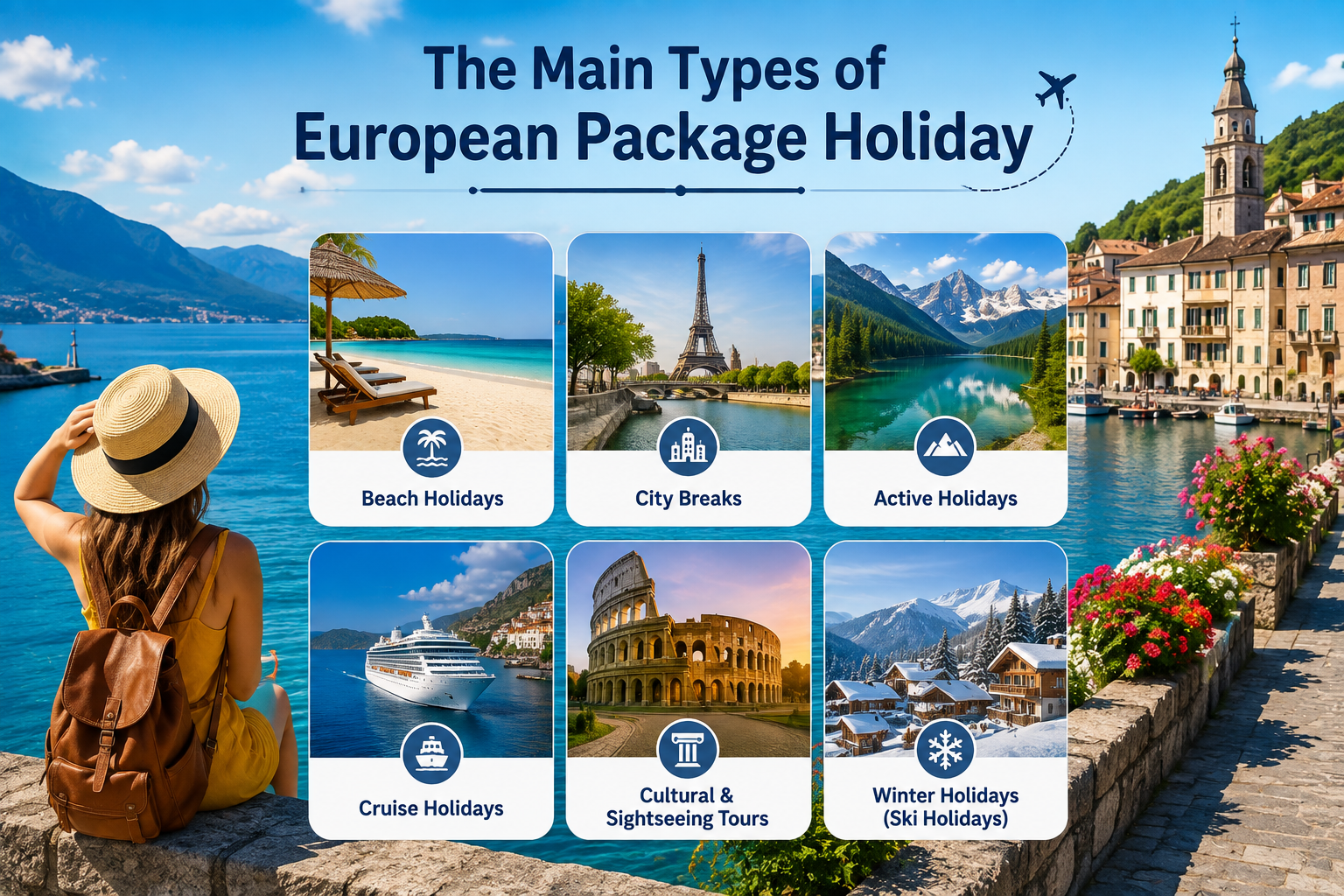
The Main Types of European Package Holiday
European package holidays generally fall into one of four types, and knowing which one you’re looking at makes it far easier to compare deals properly.
Flight + hotel resort bundles
The most common package type: flights and a hotel room, usually with transfers, bundled into one price for a beach resort or city-break destination, typically sold by UK tour operators and airline-branded holiday arms.
Best for: Travellers wanting a single fixed-date resort trip without coordinating flights and hotel separately. Main advantage: Transport and accommodation are arranged together, usually with transfers included, and the package is generally ATOL protected. Watch out for: Board type — self-catering, half-board, all-inclusive — and what “all-inclusive” actually covers can vary significantly between operators.
Coach holidays
Return coach travel from a UK departure point, accommodation, and often excursions, bundled into one price — no flight involved. Common for destinations reachable overland, such as France, Belgium, the Netherlands, and parts of Germany and Switzerland.
Best for: Travellers within reach of a UK coach pick-up point who’d rather avoid flying, or who want excursions built into the itinerary. Main advantage: One bundled price covering transport, accommodation and often sightseeing, with no transfers to arrange separately. Watch out for: Journey time is longer than flying, and as a non-flight package this is protected through ABTA or ABTOT rather than ATOL.
Multi-city rail & escorted tours
Structured itineraries across several countries or cities, travelling by rail, coach, or a mix, either fully guided with a tour leader or self-guided with pre-booked hotels and transport between stops.
Best for: Travellers who want to see several destinations in one trip without planning the logistics themselves. Main advantage: The itinerary, accommodation and inter-city transport are all arranged for you. Watch out for: These trips often carry a higher average price than a single-resort stay, and the pace can be demanding — check how many nights you get at each stop rather than just the number of countries visited.
Fly-drive & self-guided packages
Flights, a hire car, and pre-booked accommodation bundled into one price, with the itinerary and daily plans left to you.
Best for: Travellers who want maximum flexibility and are comfortable planning their own route and daily schedule. Main advantage: The most control over dates, route and pace of any package type, while still getting transport and accommodation covered by one booking. Watch out for: Car hire terms — excess insurance, fuel policy, cross-border restrictions — vary significantly by hire company and aren’t always obvious from the headline price.
Single-Country vs Multi-Country Trips
A single-country or single-resort package means less time spent travelling between stops, more time to properly settle into a destination, and simpler logistics — one hotel, one set of transfers, minimal repacking.
A multi-country trip covers more ground and suits travellers who want variety or are visiting a region for the first time, but transport time between stops eats into the days available at each location, and the daily cost of a fast-paced multi-city itinerary can be higher than the same number of nights spent in one place. Neither is the “better” choice — it depends on whether you’d rather see more places briefly or fewer places properly.
Package or Book It Yourself?
There’s a reliable pattern here, though not a fixed rule. Multi-country and escorted trips tend to favour a package, since coordinating rail tickets, hotels and transfers across several cities independently takes real planning time. Single-destination trips, particularly to well-served beach or city destinations, are a closer call — independent booking is often just as competitive, and sometimes cheaper.
| Factor | Package | Book it yourself |
| Best suited to | Multi-country trips, escorted itineraries, first-time visitors to a region | Single destinations, flexible travellers, well-served routes |
| Price clarity | One total, though extras can still apply | Each cost visible, but extras easier to miss |
| Financial protection | Usually covered as a package — scheme depends on whether a flight is included | Only protected element-by-element, if each supplier separately offers it |
| Flexibility | Lower — fixed itinerary and dates in most cases | Higher — choose every element independently |
| Best for families | Strong — one booking, less to coordinate | Workable, but more admin for a group |
| Best for existing bookings | Weaker — redundant if you already have flights or accommodation | Strong — build the trip around what you’ve already got |
| Booking effort | Low — one transaction | Higher — several bookings to coordinate |
If unsure, price both for the same dates and standard of accommodation before deciding — the gap is often smaller than it first appears, and sometimes runs the other way entirely.
Choose a package if…
- You’re visiting several countries and don’t want to plan the logistics yourself.
- You want one booking, one payment, and package-level financial protection.
- You’re travelling with children or as a larger group.
Consider DIY if…
- You already have flights or accommodation booked separately.
- You want a specific hotel or route not offered as part of any package.
- Your dates are flexible and you’re comfortable comparing suppliers yourself.
What a European Package Holiday Actually Costs
Prices move constantly with season, destination, package type, and how far ahead you book, so no specific figures are quoted here — what’s more useful is understanding what actually drives the price.
| Cost driver | What it affects |
| Time of year | School holidays and peak summer months carry a noticeable premium over off-peak dates |
| Package type | Escorted and multi-city tours generally carry a higher average price than a single-resort stay |
| Destination | Short-haul beach and city destinations are generally the most competitively priced; multi-country routes cost more |
| Board type | Self-catering, half-board, and all-inclusive carry different price structures for the same hotel |
| Trip length | More nights raise the total, though per-night cost can fall on longer stays |
| How far ahead you book | Booking early can secure better prices and availability, though occasional late deals do appear |
| Extras | Excursions, travel insurance, and car hire extras are usually priced separately from the headline package |
A rough shape for three common budgets, based on the cost drivers above rather than any specific quoted price:
- Budget-focused trip: a self-catering or half-board stay, off-peak dates, and a single short-haul destination.
- Mid-range trip: a well-located hotel, transport included, and a couple of excursions built in.
- Premium trip: a higher hotel tier, peak dates, and a fully escorted multi-country itinerary with most extras included.
Hidden costs that can change the real price
A headline price commonly excludes: airport transfers, checked baggage, meals beyond what’s specifically included, travel insurance, car hire extras, local tourist tax, and excursions booked once you arrive. Add these up before comparing two operators — the true total is often more useful than either “from” figure alone.
Financial & Legal Protection: ATOL, ABTA and ABTOT
This is worth understanding before you pay a deposit, and it changes depending on exactly how the booking is put together.
Flight-inclusive packages. Per the UK Civil Aviation Authority’s ATOL scheme, a business needs an ATOL specifically to sell flight-inclusive packages (as defined under the Package Travel and Linked Travel Arrangements Regulations 2018) or flight-only tickets, regardless of where the flight departs from. Ask to see the ATOL certificate and confirm it covers your specific booking. Should the operator or a supplier on that certificate fail financially, the Air Travel Trust can step in to arrange a refund or bring you home.
Non-flight packages. A coach holiday, rail-only tour, or accommodation-plus-excursions package with no flight still meets the legal definition of a “package,” and organisers must provide financial protection for money paid in advance — but not through ATOL, which covers flight-inclusive packages only. That protection is typically delivered instead through an ABTA bond, a Financial Failure Insurance policy, or a trust account — or, for operators outside ABTA, through ABTOT (the Association of Bonded Travel Organisers Trust) bonding.
Some operators sell both flight-inclusive and non-flight packages side by side, so an ATOL reference elsewhere on a site doesn’t necessarily mean a specific coach or rail package is ATOL protected — ask which scheme covers the booking you’re actually making.
Before paying a deposit, check:
- What exactly is included in the price?
- What financial protection scheme applies to this specific booking?
- Is there a certificate or written confirmation — an ATOL certificate number, or an ABTA/ABTOT membership number?
- What’s the process if the organiser fails financially before you travel?
This reflects how ATOL, ABTA and ABTOT protection is generally structured at the time of writing — confirm the current position directly with the organiser, and with the CAA or ABTA if in doubt.
Entry Requirements: What’s Changing for UK Travellers to Europe
Two passport rules apply to UK travellers visiting the EU and wider Schengen area: your passport generally needs to have been issued less than 10 years before your travel date, and needs at least three months’ validity remaining after your planned return date — check both separately, since a passport can pass one test and fail the other.
A further change is approaching but not yet in effect at the time of writing: ETIAS, the European Package Holidays Information and Authorisation System, is expected to start applying to UK and other visa-exempt travellers visiting the Schengen area later in 2026, requiring a low-cost online authorisation — around €20 for most adults — valid for roughly three years, in addition to a valid passport.
This timeline has shifted more than once already, so treat it as expected rather than confirmed, and check GOV.UK’s official travel guidance for the current position before you book or travel. This doesn’t replace checking the specific entry requirements for your destination country directly, since individual countries can apply additional rules beyond the general Schengen position.
When to Book for the Best Price
“Cheapest time to travel” and “best time to book” are different questions. Travelling outside school holidays and peak summer months is generally the biggest lever on price for anyone with flexible dates, while booking well ahead of school holiday periods tends to secure better prices and a wider choice of accommodation, since the best-value rooms sell out before prices necessarily rise. There’s no fixed rule guaranteeing the lowest price on any given day, and late deals do appear occasionally on less popular dates — worth watching for if flexible, but not something to rely on for a specific hotel or fixed dates.
Who European Package Holidays Suit Best
First-time visitors to a region generally get the most value from a package, particularly a multi-country or escorted one, since the planning is handled for you. Families booking together tend to benefit from one fixed price and less admin.
Larger groups and multi-generation trips benefit from a single shared booking rather than several people separately arranging flights, hotels and transport. Travellers with existing flights or accommodation, or a preference for a specific hotel not offered as part of any package, are often better served booking independently. Flexible, experienced travellers who enjoy planning their own route may find a fly-drive or self-guided package a better middle ground than a fully packaged itinerary.
Common Mistakes
- Assuming every “European package holidays” carries the same protection. Flight-inclusive and non-flight packages are protected through different schemes.
- Underestimating transport time on multi-country trips. A packed itinerary can leave less time at each stop than it first appears.
- Comparing headline prices without matching inclusions. Board type, transfers, and excursions can differ significantly between similarly priced deals.
- Not checking current entry requirements, including passport validity and the upcoming ETIAS authorisation.
- Booking accommodation alone to save a little, without realising this can remove the package-level protection that comes with buying it alongside transport.
How to Choose: A Decision Framework
- Single destination or multiple countries? A multi-country trip generally favours a package; a single destination is worth pricing both ways.
- How much planning do you want handled for you? More points toward an escorted or flight-inclusive package; less points toward fly-drive or DIY.
- Do you already have flights or accommodation booked? If so, a non-flight or independent route usually makes more sense.
- Check what financial protection applies — ATOL, ABTA, or ABTOT — before paying a deposit.
- Confirm current entry requirements for your destination and travel dates before committing.
How to Compare Two European Package Holiday Deals Properly
Once you’ve shortlisted two or three options, compare them properly rather than by headline price alone:
- Number of nights and how they’re split across destinations, if more than one.
- Transport included — flight, coach, rail, or none.
- Transfers included, particularly for flight-inclusive deals.
- Board type — self-catering, half-board, all-inclusive, or none.
- Excursions included versus optional and paid locally.
- Financial protection — which scheme covers this specific booking.
- Cancellation and amendment terms.
- Final total price — after everything above is accounted for, not the headline figure.
A lower headline price with fewer inclusions and weaker protection terms isn’t automatically the better deal.
Pre-Booking Checklist
- Confirmed which transport type the package includes, if any
- Checked board type and what’s included in meals/drinks
- Compared at least two operators for the same dates and standard
- Confirmed which financial protection scheme applies (ATOL / ABTA / ABTOT)
- Checked what’s excluded — transfers, excursions, insurance
- Checked passport validity against both the 10-year and 3-month rules
- Checked the current ETIAS position on GOV.UK if travelling later in 2026 or beyond
- Reviewed cancellation and amendment terms before paying a deposit
Frequently Asked Questions
Q: Are European package holidays ATOL protected?
A: Only if the package includes a flight, non-flight packages — coach holidays, rail-only tours — are usually protected instead through ABTA or ABTOT.
Q: What’s included in a typical European package holiday?
A: Most commonly transport (flight, coach, or rail) and accommodation, sometimes with transfers, excursions, or meals — exact inclusions vary by operator and package type.
Q: Is a package cheaper than booking everything separately?
A: It depends on the destination and package type. Multi-country and escorted trips often favour a package; single-destination trips are a closer call worth pricing both ways.
Q: Do I need a new travel document for Europe from 2026?
A: UK passport holders don’t currently need an additional document, but ETIAS — a low-cost online travel authorisation — is expected to apply to Schengen-area visits later in 2026. Check GOV.UK for the current position before booking, since the timeline has shifted.
Q: What passport validity do I need for European travel?
A: Generally, your passport should have been issued less than 10 years before your travel date and have at least three months’ validity remaining after your planned return date.
Q: Is a coach holiday to Europe a genuine package under UK law?
A: Generally yes, if the coach travel, accommodation, and other services are sold together for one price — it just isn’t protected through ATOL, since ATOL applies only where a flight is included.
Q: How far in advance should I book?
A: There’s no fixed rule, but booking well ahead of school holiday periods tends to bring better prices and a wider choice of accommodation.
What’s the difference between an escorted tour and a self-guided package? An escorted tour includes a tour leader and a fixed group itinerary; a self-guided package provides pre-booked transport and accommodation but leaves the day-to-day plan to you.
Finally
There’s no single best european package holiday — there’s a best fit for how many destinations you want to cover, how much planning you’d rather not do yourself, and what you’re prepared to pay for that convenience. Multi-country and escorted trips generally make the strongest case for a package; single-destination trips are worth pricing both ways. Whichever you choose, confirming the financial protection attached to your booking and checking current entry requirements are the two steps worth doing before you pay a deposit — not after.