

Vacation Trip Packages
Vacation trip packages promise convenience — one price, one booking, less to organize. But “package” can mean several different things depending on where you book it: a pre-bundled resort deal, a build-your-own flight-and-hotel combination, a cruise-inclusive itinerary, or a guided tour sold at a single price. That difference matters more than most search results let on, because it changes both what you’re paying for and what protects your money if something goes wrong.
This article isn’t trying to sell you a package — it’s trying to help you evaluate one: what the different types actually include, when bundling beats booking pieces separately, what the real costs look like once fees are added, and how financial protection actually works in the US, where it’s far more fragmented than travelers often assume.
Quick answer: A vacation trip package bundles two or more travel services — usually flights and a hotel, sometimes with a rental car or activities — into a single booking. Pre-built packages and all-inclusive resort deals tend to offer better value on international or high-demand routes, while flexible domestic trips are often just as cheap booked piece by piece.
Financial protection isn’t automatic: it depends on whether the seller is ARC-accredited, registered under a state Seller-of-Travel law, and whether you’ve added a travel protection plan.
Why Vacation Trip Package Search Results Don’t Actually Help You Decide
Search “vacation trip packages” and the results are almost all booking engines — Expedia, Travelocity, Costco Travel, the vacation divisions of United, American and Southwest, Kayak, Travelzoo. That’s not an accident; it’s what a commercially-loaded keyword like this one rewards.
Every one of those pages is built to get you to a checkout screen, not to help you understand what you’re buying. None of them explain, in plain terms, what actually separates a “package” from a plain flight-and-hotel booking, what protects your deposit if a company fails, or when a package genuinely beats booking the same trip yourself rather than simply being the easier option to click. That’s the gap this article is built to fill.
What Actually Counts as a “Vacation Trip Package”
Not every bundled deal is structured the same way, and the distinction affects both price and protection. A vacation package, in the way the travel industry generally uses the term, combines at least two travel services — most often a flight and a hotel, sometimes with a rental car, transfers or activities — sold and paid for as a single booking.
There are two broad ways this happens. A pre-built package is assembled by an operator or an airline’s vacation division (Funjet, United Vacations, American Airlines Vacations and similar) and sold as a fixed itinerary, sometimes with a limited set of customizable options. A dynamic package is built by the traveler, using a site like Expedia or Kayak to combine a chosen flight and hotel into a single transaction — priced, and often discounted, as one purchase even though the components come from different suppliers.
Both are commonly called “packages,” and both can offer genuine savings over booking each piece entirely separately. But the protection behind them isn’t identical, which is worth knowing before you compare prices — more on that in the Protection section below.
Types of Vacation Trip Packages
Most vacation trip packages fall into one of four broad categories, and knowing which one you’re looking at makes it easier to compare like with like.
All-Inclusive Resort Packages
All-inclusive resort packages bundle flights, accommodation and most food and drink into one price, and they’re most common for beach destinations in Mexico, the Caribbean and Central America. What “all-inclusive” actually covers varies significantly by resort brand and tier: most include buffet dining, house-brand alcohol and some activities, but premium restaurants, top-shelf spirits, spa treatments, motorized watersports and excursions are frequently charged separately even at resorts marketed as fully inclusive.
Two packages listed at the same headline price can genuinely differ in what’s covered, so it’s worth checking the resort’s own inclusions list — not just the booking site’s summary — before assuming two options are equivalent.
Flight + Hotel Bundles
Flight-and-hotel bundles are the most common package type and the one most booking sites default to. Bundling tends to save the most on international routes, peak travel dates and destinations where flight demand is high relative to seat supply — the discount comes from the seller combining inventory it already holds at negotiated rates, not from any inherent advantage of “packaging” itself.
On flexible domestic trips with plenty of flight and hotel competition, the bundled price and the sum of two separate bookings are often close enough that the difference comes down to convenience rather than genuine savings. Most bundles allow adding a rental car or a small number of activities at checkout, usually at a modest cost over booking those separately.
Build-Your-Own / Custom Packages
Dynamic packaging tools — the kind built into Expedia, Kayak and similar sites — let travelers choose a specific flight and a specific hotel and have the site combine them into one purchase, sometimes at a lower combined price than booking each separately.
The appeal is flexibility: you’re not limited to a pre-set itinerary. The trade-off is that the protection attached to a dynamically built package can be less clear-cut than a pre-built one, since the components may come from different suppliers governed by different terms — worth checking before assuming it behaves exactly like a traditional package.
Cruise Packages & Guided Tours
Cruise-inclusive packages and escorted or guided tours are a distinct category, sold by operators like Costco Travel and specialist tour companies rather than general booking sites. A cruise package typically bundles flights, transfers and the cruise fare together; a guided tour bundles transport, accommodation and a structured itinerary with a tour leader.
Both are priced and marketed as a single “Vacation Trip Packages” but the day-to-day inclusions, cancellation terms and what happens if the operator itself fails can differ substantially from a resort or flight-and-hotel package — so it’s worth reading the specific operator’s own terms rather than assuming the general guidance here applies identically to a multi-week guided tour.
Package or Book It Yourself?
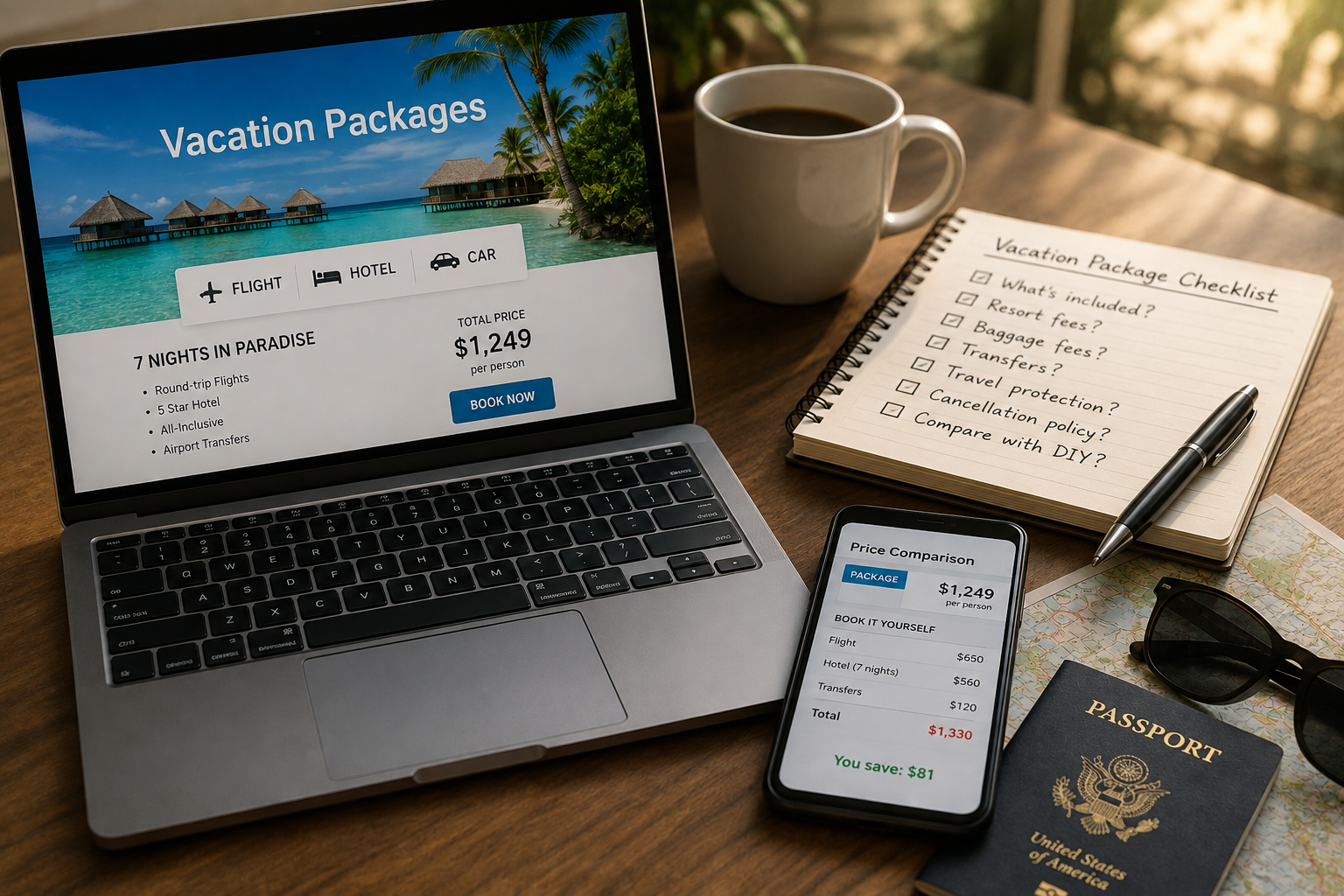
There’s a reasonably reliable pattern here, even though it isn’t a fixed rule. International trips, high-demand dates (holiday weeks, school breaks) and destinations where flight capacity is limited tend to favor a package, because the seller’s bundled rate is often genuinely cheaper than piecing the same trip together independently. Flexible domestic trips, or dates with strong airline and hotel competition, are a closer call — DIY booking is frequently just as cheap, sometimes cheaper, once you account for the flexibility to choose exactly the flight times and hotel you want.
|
Factor |
Package |
Book it yourself |
|
Best suited to |
International trips, peak dates, high-demand routes |
Flexible domestic trips, strong local competition |
|
Price clarity |
One total, though extras can still apply |
Each cost visible, but extras easier to miss |
|
Protection |
Varies by seller — check ARC/state registration |
Depends on how each piece was booked |
|
Flexibility |
Lower — usually a fixed itinerary |
Higher — choose every element |
|
Booking effort |
Low — one transaction |
Higher — several bookings to coordinate |
If you’re not sure which route wins for your specific trip, price both for the same dates and hotel standard before deciding. The gap is often smaller than either a booking site or a flight-comparison tool would suggest, and sometimes it runs the other way entirely.
What a Vacation Package Actually Costs
Headline “from $X” prices are a starting point, not a total. Resort fees (common at many US, Caribbean and Mexican properties, charged per night on top of the room rate), baggage fees, ground transfers, optional excursions, travel protection and single-supplement pricing for solo travelers typically sit outside the advertised figure — and it’s this gap, more than the destination itself, that usually explains why a booking ends up costing more than the search result implied.
|
Package type |
Typical cost driver |
What’s often missing from the headline price |
|
All-inclusive resort |
Flight + resort rate |
Resort fee, premium dining/drinks, excursions |
|
Flight + hotel bundle |
Flight (often the largest single cost) + room rate |
Baggage, transfers, resort fees |
|
Build-your-own / dynamic |
Chosen flight + chosen hotel |
Add-on protection, change fees |
|
Cruise or guided tour |
Base fare or tour price |
Gratuities, shore excursions, single supplement |
These are cost categories worth checking, not price estimates — actual figures vary too much by destination, season and operator to state a reliable dollar range here. Building a rough total yourself, using the real prices quoted for your specific dates, is the only reliable way to compare two options.
Financial & Legal Protection: What Actually Covers You
This is the part of booking a vacation package that gets the least attention, and it’s more fragmented in the US than travelers often assume. Unlike the UK, which has a single national scheme (ATOL) covering flight-inclusive packages, the US has no single federal consumer-protection fund for package travel. Protection instead comes from a mix of sources, and which ones apply depends on how and where you book.
ARC accreditation. The Airlines Reporting Corporation (ARC) accredits travel agencies that meet certain financial and operational requirements to issue airline tickets through the same settlement system airlines use. It’s a meaningful signal that an agency meets defined financial standards to operate — but it isn’t, by itself, a guarantee fund that refunds travelers if a company collapses.
State Seller-of-Travel registration. Five states — California, Florida, Hawaii, Iowa and Washington — require sellers of travel to register, and some of that registration includes a bond or, in California’s and Washington’s case, a restitution fund travelers can claim against if a registered seller fails. Booking with a company registered in one of these states adds a layer of protection that doesn’t exist everywhere else in the country.
Travel protection plans. Optional third-party plans, sold at checkout or separately, can cover trip cancellation, interruption and, in some cases, supplier default — but coverage varies significantly by plan, so it’s worth reading exactly what’s covered rather than assuming “travel insurance” means the same thing everywhere.
The practical takeaway: ask, before paying a deposit, what specifically protects your money if the operator or airline fails — and don’t assume the answer is the same for every package type or seller.
When to Book for the Best Price
There’s no universal rule for the best booking window, and it’s worth being wary of any source that states one as fact. As general guidance, international and high-demand routes are often released furthest in advance and can see prices climb as the departure date and peak dates (holiday weeks, school breaks) approach, while domestic and off-peak trips sometimes see better deals appear closer to departure as sellers try to fill remaining inventory.
The more reliable approach is to track prices for your specific dates over a few weeks rather than book on the first price you see, and to book with more lead time when your dates are fixed to a school break or a major holiday, since those dates sell out — and rise in price — the most predictably.
Who Vacation Packages Suit Best
Families traveling around school breaks tend to get the most value from a package, partly because kid-stay-free and group offers are more commonly attached to pre-built packages than to individually booked flights and hotels — worth checking the specific age cutoffs and blackout dates before assuming an offer applies to your trip.
First-time international travelers, or anyone who wants a single point of contact if plans change, often find the bundled structure genuinely reduces the coordination burden. Milestone trips — honeymoons, anniversaries, multigenerational family trips — frequently suit a package for the same reason. Experienced travelers booking flexible domestic trips, or those who specifically want a boutique hotel a package provider doesn’t offer, often do just as well, or better, piecing the trip together themselves.
Are Airline Miles or Loyalty Points Worth Using on a Package?
United, American and Southwest all sell Vacation Trip Packages through dedicated divisions that let travelers earn miles on the booking, and some allow redeeming points toward part of the cost. Whether that’s a good use of points depends entirely on the redemption value at the time — miles redeemed for a package are sometimes worth less than the same miles saved for a specific flight redemption, so it’s worth comparing the points required against what you’d pay in cash, and against what those points could get you elsewhere, before redeeming them on a bundled package rather than simply earning them from it.
Common Mistakes
- Assuming “all-inclusive” means identical coverage at every resort. Check the specific inclusions list, not just the marketing label.
- Not confirming what protects your deposit. ARC accreditation, state registration and travel protection plans cover different things, and not every seller has all three.
- Comparing only the headline price, not the full cost. Resort fees, baggage and transfers can add a meaningful amount once they’re all included.
- Treating a dynamically built package as automatically protected like a pre-built one. Check rather than assume.
- Booking a package tied to a fixed school-break date without pricing it well in advance, then being surprised the price has climbed.
How to Choose: A Decision Framework
- International trip or high-demand dates? Lean toward a package unless you’ve priced DIY for the same dates and found a clear saving.
- Flexible domestic trip? Price both routes — the outcome genuinely varies by dates and destination.
- Traveling with a group that needs one point of contact if plans change? A package usually reduces coordination risk.
- Whatever you choose, confirm what protects your money — ARC accreditation, state registration, or an added protection plan — before paying a deposit.
- Dates fixed to a school break or major holiday? Book with more lead time; those dates are the most predictable to rise in price.
Pre-Booking Checklist
- Confirmed exactly what’s included vs. excluded in the headline price
- Confirmed what financial protection applies to this specific booking (ARC, state registration, protection plan)
- Compared the same dates and hotel standard against a DIY booking
- Checked the cancellation and change policy
- Checked for a resort fee or single-supplement charge
- Noted the deposit amount and balance due date

Frequently Asked Questions
Is it cheaper to book a Vacation Trip Packages or arrange flights and a hotel separately?
It depends on the trip. International routes, peak dates and high-demand destinations often favor a package, since the seller’s bundled rate can beat piecing the same trip together independently. Flexible domestic trips are a closer call — price both before deciding.
What’s included in a typical Vacation Trip Packages?
Most commonly a flight and a hotel room, sometimes with transfers, a rental car or activities. All-inclusive packages add most food and drink; premium dining, spa treatments and excursions are frequently charged separately even then.
Are Vacation Trip Packages financially protected if the company goes out of business?
It depends on the seller. There’s no single national protection scheme in the US the way the UK has ATOL. ARC accreditation, registration in one of the five states that require it (California, Florida, Hawaii, Iowa, Washington), and optional travel protection plans each cover different things — ask specifically what applies before paying a deposit.
Is all-inclusive worth it for a Vacation Trip Packages?
Usually on longer trips, or in destinations where eating and drinking independently is expensive. On short breaks, or where a resort’s inclusions are limited, a room-only or breakfast-included rate can work out similar in total cost.
How far in advance should I book a Vacation Trip Packages?
There’s no fixed rule. International and high-demand routes are often released furthest ahead and can rise in price as peak dates approach, while some domestic and off-peak deals appear closer to departure. Tracking prices for your specific dates is more reliable than following a general booking-window rule.
Can I use airline miles or points toward a Vacation Trip Packages?
Some airline vacation divisions (United, American, Southwest) allow it, but the redemption value varies — compare the points required against the cash price, and against other uses of those points, before redeeming them on a bundled package.
What’s the difference between a pre-built package and a dynamic package?
A pre-built package is assembled by an operator or airline vacation division and sold as a set itinerary. A dynamic package is built by the traveler on a site like Expedia or Kayak, combining a chosen flight and hotel into one transaction — often at a discount, but sometimes with less clear-cut protection than a traditional package.
Conclusion
There’s no single best Vacation Trip Packages — there’s a best fit for your dates, destination, and how much you value flexibility versus convenience. For international trips, peak dates, or a family that wants one point of contact, a package is very likely worth booking, though it’s still worth pricing DIY once to confirm. For flexible domestic trips, price both routes properly before committing either way. And whichever you choose, confirming what protects your deposit is the one step worth doing before you pay it, not after.